


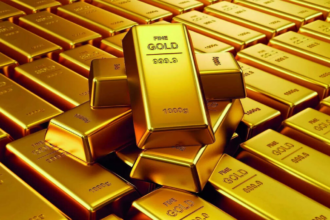
Gold prices declined by around 1% in global markets on Tuesday, mainly due to a stronger U.S. dollar and thin trading activity across major Asian markets. Spot gold fell nearly 0.9% during early Asian trading, while U.S. gold futures saw an even sharper drop of about 1.6%. This decline reflects short-term pressure on gold, even though long-term fundamentals remain relatively supportive.
One of the biggest reasons behind the fall in gold prices was the strengthening of the U.S. dollar. The dollar index rose slightly against other major currencies, which made gold more expensive for international buyers. Since gold is priced in dollars globally, a stronger dollar reduces its affordability for investors holding other currencies. This usually leads to lower demand and puts downward pressure on gold prices.
Another key factor was thin trading activity due to multiple market holidays. Several major Asian markets, including China, Hong Kong, Singapore, Taiwan, and South Korea, were closed for Lunar New Year celebrations. Additionally, U.S. markets were shut the previous day due to Presidents’ Day. When fewer traders participate in the market, liquidity falls, and even small selling pressure can lead to bigger price movements. This low participation amplified the decline in gold prices.
Apart from gold, other precious metals also experienced weakness. Silver prices fell sharply by around 2.7%, while platinum declined about 0.8%, and palladium dropped roughly 1.5%. This indicates that the weakness was not limited to gold alone but reflected broader pressure across the precious metals segment.
Despite the short-term decline, the long-term outlook for gold still remains supported by expectations of interest rate cuts. Investors are closely watching the policy direction of the Federal Reserve. Markets currently expect multiple rate cuts later this year. Lower interest rates typically support gold prices because gold does not offer interest income. When interest rates fall, returns on bonds and savings decline, making gold more attractive as a safe-haven investment.
Gold is widely seen as a safe-haven asset during times of uncertainty, inflation, or economic instability. Even though prices declined in the short term due to dollar strength and low liquidity, long-term demand drivers such as inflation concerns, central bank buying, and rate cut expectations continue to support gold.
Market experts believe that the current decline is largely technical and liquidity-driven rather than a major shift in gold’s overall trend. Once trading volumes normalize and market participation increases, gold prices may stabilize. Investors are also waiting for clearer signals on inflation, economic growth, and central bank policy before making major investment decisions.
Overall, the recent fall in gold prices highlights how currency strength and trading liquidity can influence short-term price movements. While the stronger dollar and holiday-related thin trading pressured prices temporarily, gold’s long-term outlook remains closely linked to interest rates, inflation trends, and global economic uncertainty.