




Written By: Nishant Parsad
The Growing Hype Around SME IPOs
Imagine stepping into a carnival where everyone is excited about a game that promises quick money. People eagerly join in, not because they understand the game, but because they’ve heard others won big. That’s exactly what the SME IPO market feels like today—a rush driven by the promise of high listing gains.
From its start in 2012, SME IPOs have grown rapidly in popularity. Retail investors are now putting in large amounts of money, hoping for quick profits. However, beneath the excitement lies a mix of risks, potential manipulation, and limited regulation.
In this guide, we’ll uncover the real story of SME IPOs—what they are, why they’ve become a bubble, the dangers they pose, and the steps SEBI is taking to regulate them. If you’ve ever wondered whether SME IPOs are worth the hype, this article is your ultimate walkthrough.
Why Were They Created?
SME IPOs are designed for Small and Medium Enterprises (SMEs) to raise funds by selling shares to the public. These businesses, which drive a significant portion of India’s economy, often struggle to secure traditional bank loans. High-interest costs, collateral requirements, and the fixed repayment structure of loans make equity financing a more attractive option.
To address this, the government launched SME exchanges in 2012 under the NSE (EMERGE) and BSE (SME) platforms. These platforms offer a simpler and cheaper route for smaller businesses to access public capital.
Eligibility Criteria for SME IPOs:
- Paid-up capital must not exceed ₹25 crores.
- The company must have been operational for at least three years.
- Positive net worth, meaning assets must exceed liabilities.
These exchanges were meant to support businesses like the small factories in Jamshedpur or local steel plants, which collectively provide employment to half of India. By offering SMEs an alternative to loans, the government hoped to boost liquidity in this crucial sector.
The Rise of the SME IPO Bubble
When SME IPOs were introduced, they had modest beginnings:
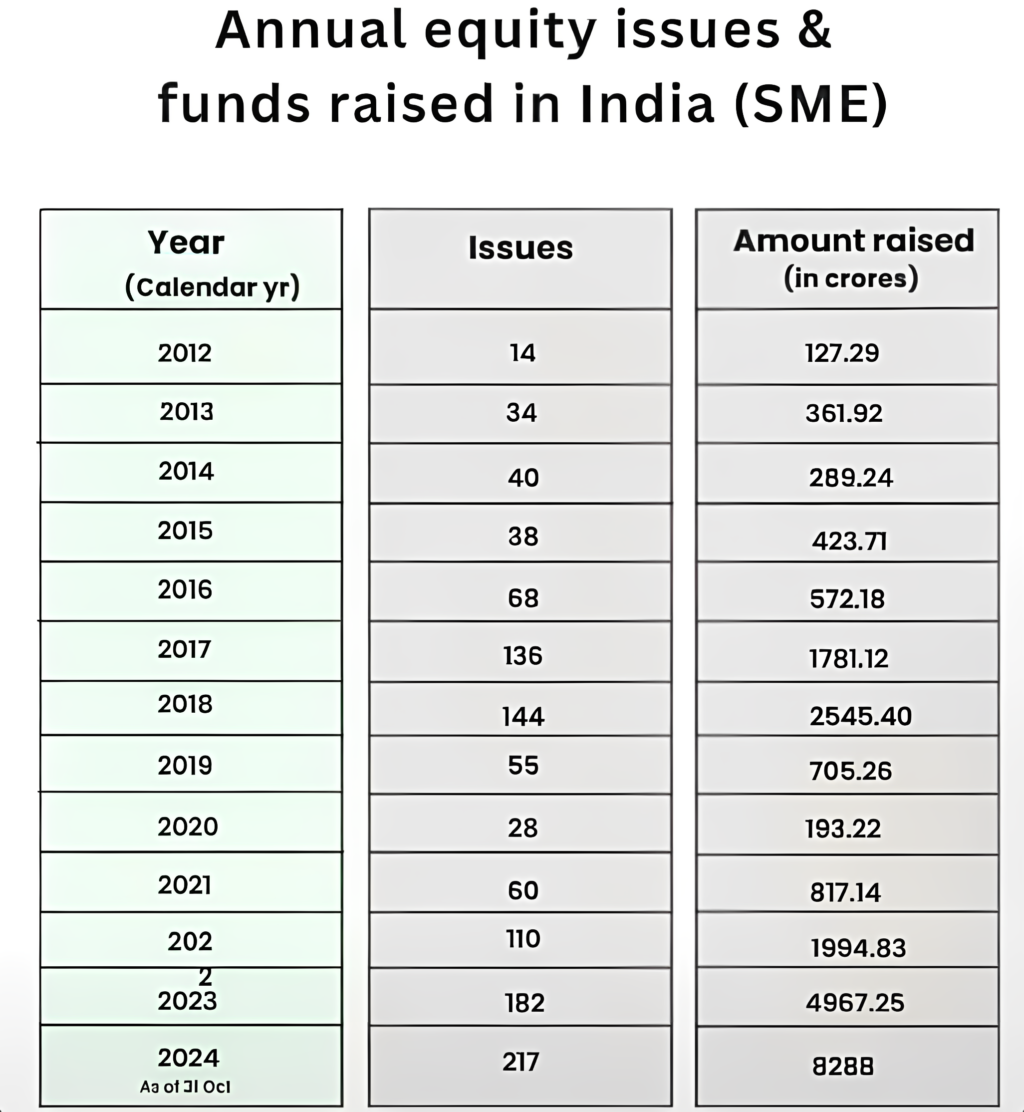
- 2012: 14 issues raised just ₹127 crores.
- 2024: Over 200 issues rose nearly 8,000 crores in a single financial year.
But the real story isn’t just the growth in size, it’s the dramatic increase in retail investor participation and listing gains:
- In 2015, only 299 investors participated per SME IPO.
- By 2024, that number had jumped to 28,000 participants per IPO, with median listing gains hitting 34%, higher than the average of 23%.
What’s Driving the Frenzy?
It’s simple: greed for quick profits. Investors see SME IPOs as a lottery ticket, betting on massive listing gains. For instance, an SME IPO that raised ₹5 crores in 2023 was oversubscribed 400 times, with retail investors scrambling to secure a piece of the pie.
But as Warren Buffett wisely warns:
“Be fearful when others are greedy, and greedy when others are fearful.”
The Lure of Listing Gains: Is it Gamble?
SME IPOs attract retail investors with the promise of big returns on the listing day. Here’s how it works:
To apply for an SME IPO, you need a minimum investment of ₹1 lakh—a far cry from the ₹15,000 required for mainboard IPOs. For many, this feels like a high stakes bet, but the potential rewards seem worth it.
Example:
Let’s say you invest ₹1 lakh in an SME IPO. If the stock price rises by 72% on listing day, you pocket a net profit of ₹72,000. For retail investors, this is a tantalizing prospect, even if it’s essentially speculative gambling.
But here’s the catch: not every IPO delivers gains. Many SMEs have opaque operations, limited transparency, and questionable governance, making them inherently risky investments.
The Risks
While SME IPOs may promise glittering gains, they’re often fraught with risks:
1. Lack of Transparency
Unlike large companies like TCS or Reliance, many SMEs are small, family-run businesses with limited publicly available information.
Example: A fictional company, “Lalu Softech Pvt. Ltd.,” operates out of Prayagraj. It started as a cybercafé, transitioned to drop-shipping, and now claims to be an IT giant. Investors are left in the dark, relying solely on the company’s word.
2. High Dependency on Promoters
SMEs are often run by one or two key individuals. If they leave or mismanage funds, the company’s future can collapse.
3. Manipulation of Funds
Promoters can misuse IPO proceeds through related-party transactions or circular dealings.
Example: A promoter raises ₹30 crores via IPO, lends it to a shell company owned by their brother-in-law, and siphons off funds under the guise of “business expenses.”
4. Illiquidity
Once listed, SME stocks often lack sufficient trading volume, making it hard to exit without incurring losses.
SEBI’s Crackdown
Recognizing the dangers of the SME IPO bubble, SEBI (Securities and Exchange Board of India) has introduced sweeping reforms to clean up the space.
1. Increasing the Bid Size
SEBI proposes raising the minimum application size from ₹1 lakh to ₹2 lakh. This move is designed to:
- Discourage speculative retail investors.
- Align the IPO application size with the 2.5x growth of Sensex and Nifty since 2012.
2. Introducing Lottery-Based Allotments
Previously, shares were allocated proportionately, favoring large bidders. SEBI now proposes a lottery system to ensure smaller investors get fair access.
3. Tightening Fund Monitoring
For IPOs above ₹20 crores, SEBI will require:
- Appointment of a monitoring agency to track how funds are used.
- Regular six-month reports to ensure funds aren’t diverted to unrelated projects.
4. Restricting Offer for Sale (OFS)
SEBI plans to limit OFS to 20% of the total IPO size. This ensures the focus remains on raising fresh capital rather than providing an exit for existing shareholders.
5. Extending Promoter Lock-In Periods
Promoters currently must retain 20% of shares for three years post-IPO. SEBI proposes extending this lock-in period to five years to ensure long-term commitment.
Conclusion
The SME IPO bubble represents both the promise and peril of small-cap investing. While these IPOs can deliver impressive gains, they often come with hidden risks. With SEBI stepping in to regulate the space, there’s hope for a cleaner, more trustworthy SME market.
For investors, the lesson is simple: don’t chase the hype. Do your homework, scrutinize the business model, and remember—what glitters isn’t always gold.