



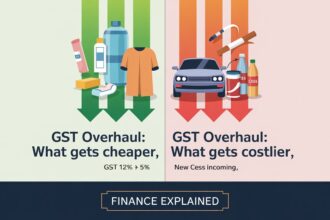
The Indian government is planning a big change in how GST (Goods and Services Tax) is charged. The main goal is to make the tax system simpler and to reduce the prices of important daily-use items. This change will be discussed in the upcoming 56th GST Council meeting. If it gets approved, it could have a big impact on both consumers and businesses.
Right now, many common products are taxed at 12%. The government wants to either remove the 12% GST rate or move many of these items to the 5% tax slab. This means many things people use every day could become cheaper. Some of these items include toothpaste, soap, kitchen utensils, small washing machines, pressure cookers, electric irons, umbrellas, bicycles, clothes priced above ₹1,000, and footwear between ₹500 and ₹1,000. This move could help middle-class families and make life a little more affordable.
Items used in education and healthcare may also become cheaper. Things like notebooks, stationery, maps, vaccines, diagnostic kits, and farming tools could be moved to the 5% GST slab. Making these products cheaper will help students, patients, and farmers. It also fits with the government’s goal of improving accessibility to education and healthcare.
On the other hand, the government is also planning to increase taxes on certain items that are seen as harmful or luxury goods. These include cigarettes, tobacco products, soft drinks, expensive cars, and coal. Right now, these already have a high tax of 28%, but the government may add two new taxes on top of that: a health cess and a clean energy cess. These new charges are meant to reduce harmful consumption and raise money for public health and environmental projects.
This change could cause the government to lose ₹40,000 to ₹50,000 crore in tax revenue at first. But officials believe that if prices of daily items go down, people will buy more, and the government will earn that money back over time. Also, a simpler system may encourage more businesses to come into the tax network, which would help increase overall collections.
However, not everyone agrees with this plan. Some states like Punjab, Kerala, Madhya Pradesh, and West Bengal are worried that lower taxes will reduce their income. Since GST is a joint system between the Centre and the States, any change needs majority agreement. Also, the GST Council must give at least 15 days’ notice before voting, so final approval may take a few more weeks.
This is part of a larger push to simplify GST. At present, there are four tax slabs—5%, 12%, 18%, and 28%—which many believe is too confusing. The government is also considering bringing petrol and diesel under GST, which would further simplify the system and possibly lower fuel prices.
If the Council agrees, these changes could be implemented within this quarter. Consumers may soon see new, lower prices on essential items, while luxury or harmful goods could become more expensive. Businesses will need to update labels and adjust prices quickly.
In short, this GST reform could transform India’s tax system, making it simpler, fairer, and more focused on affordability and public welfare. Whether it goes through depends on the final decision by the GST Council in the coming weeks.