




Written By: Nishant Parsad
Let’s begin with the picture everyone loves to paint about India: a fast-growing economy, surging consumption, record credit demand, and booming real estate. But behind that picture lies a quieter, more complex truth that the Reserve Bank of India’s latest Financial Stability Report just brought to light.
Yes, India is spending more. But who exactly is doing the spending?
The answer, according to the RBI, is: the rich.
And not just spending from income, but spending from leverage.
The Rise of Borrowed Consumption
The report reveals a key trend: while India’s household savings are rising, household debt is rising faster.
As of March 2025:
– Household debt = 41.9% of GDP (vs 34.9% in March 2019)
– Non-housing retail loans = 54.9% of total household debt
– Housing loans = 29% (and increasingly going to existing, affluent borrowers)
– Per capita debt = ₹4.8 lakh, up from ₹3.9 lakh just two years ago
At first glance, this looks stable. India’s household debt is still lower than many emerging markets. But the composition and quality of that debt are shifting fast — and not necessarily in a healthy direction.

Who’s Borrowing – And Why?
The RBI data is crystal clear: the wealthiest, highest-rated borrowers are taking on the most debt. In fact:
– Over one-third of new housing loans (as of March 2025) were top-up loans (A top-up loan is an additional loan given by a bank or lender on top of an existing loan (usually a home loan or personal loan) for the same borrower) by existing borrowers.
– Prime borrowers (Individuals with a good credit score (typically 700–750+), strong repayment history, and stable income — considered low-risk by lenders) and super-prime borrowers (Super-prime borrowers are the best quality borrowers, usually with excellent credit scores (750–800+), very strong financials, and zero defaults — considered ultra-low risk) are taking the lion’s share of new personal and retail loans.
– And most strikingly, more than half of household debt is now for consumption, not asset creation.
So, what we’re seeing is not the underserved finally accessing credit. We’re seeing the affluent using their asset base to borrow more — and then spend more.
Think high-end electronics, premium cars, luxury apartments, and lifestyle spending. This is wealth-fuelled, leverage-backed consumption.
Why This Looks Good on Paper (But Isn’t the Whole Picture)
From a financial stability angle, this seems positive:
– Prime borrowers have lower delinquency risk (Delinquency risk means the chance that a borrower misses loan payments — either partially or fully — after the due date)
– Lenders are less exposed to defaults
– Credit growth continues without spiking NPA risk
But here’s the catch: the quality of GDP growth is becoming skewed.
The data points toward a K-shaped economy, where the top-end sees rising access to wealth and credit, while the bottom remains vulnerable, under-leveraged, and unable to participate meaningfully in the consumption story.
The Wealth Effect vs. Reality
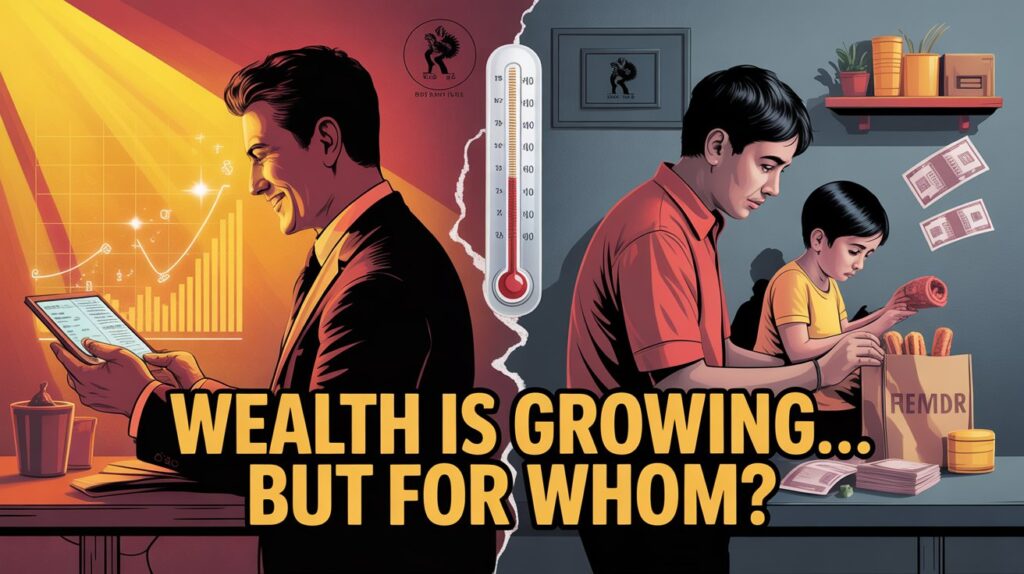
The RBI notes that nearly one-third of the rise in financial wealth in 2023-24 came from asset price appreciation, not savings. This “wealth effect” means that when people see their portfolio values rise, they feel richer and spend more, even if their income hasn’t increased proportionately.
This creates a feedback loop:
– Richer people invest more
– Asset prices go up
– They borrow more cheaply
– They spend more
– GDP grows
But meanwhile, the average middle-class or lower-income Indian is:
– Facing real wage stagnation
– Experiencing high food and education inflation
– Unable to borrow on attractive terms
– Watching the consumption train speed by
That’s a demand divergence that macroeconomic averages can easily mask.
The Warning Signs in the Shadows
The report doesn’t ignore the lower end of the credit spectrum:
– Loan-to-value (LTV) ratios over 70% are rising, especially among lower-rated borrowers.
– Delinquency is still elevated among sub-prime segments, even though post-COVID levels have improved.
– The spike in gold loans and continued stress in microfinance point to bottom-tier distress.
So while the headline is, “India is consuming more,” the subtext is, “But not everyone can afford to.”
And if the lower-income segments fall further behind in this credit-led growth model, it may start affecting financial inclusion, demand stability, and eventually, even political and economic cohesion.
What This Means for the Economy
Credit-led consumption is a powerful short-term growth engine. But when:
– That credit is concentrated among the top 10% of earners
– The bottom 50% remains largely excluded
– Asset appreciation drives borrowing more than wage growth
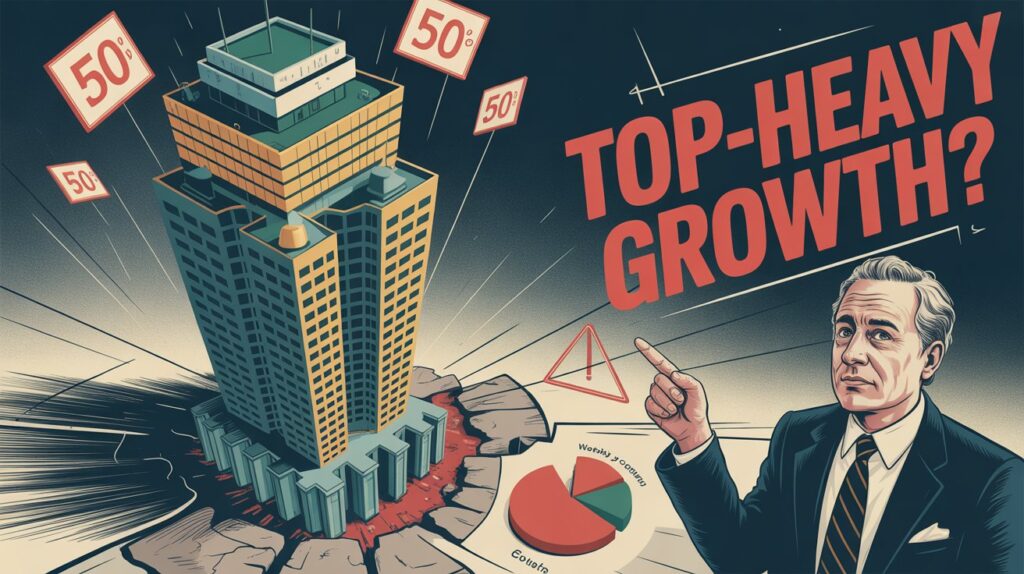
the economy becomes increasingly top-heavy.
Yes, India may be growing fast. But if that growth is not broad-based, it’s not sustainable.
Just like a building that looks tall but rests on a narrow base.
Final Thought: Growth for Whom?
The RBI’s report is nuanced. It doesn’t ring alarm bells. But it does flash amber lights.
We must ask:
– Are we mistaking affluence for inclusion?
– Are we prioritizing credit metrics over equitable access?
– Can we call this a true consumption boom if it excludes half the country?
In the short term, this kind of growth looks great on charts. But in the long run, a consumption story driven only by the top end of the pyramid may leave the base crumbling.
And that’s a risk no financial system — however stable — should ignore.