



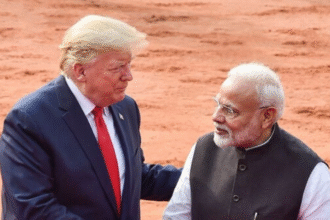
India and the United States recently conducted a 2+2 Intersessional Dialogue on August 25, 2025, marking the first official high-level engagement between the two nations in recent weeks. The talks took place virtually and brought together senior officials from both sides to discuss key issues ranging from defense and security to trade and investment, even as tensions remain over U.S. tariffs on Indian goods.
The dialogue reflects both countries’ efforts to maintain strategic relations despite ongoing economic disagreements. The U.S. had recently imposed 50% total tariffs on a large portion of Indian exports, citing India’s continued imports of discounted Russian oil. This action affected labor-intensive sectors like textiles, jewelry, and chemicals, raising concerns over export-driven jobs and economic stability.
During the 2+2 discussions, defense and security cooperation took center stage. Officials reviewed plans to finalize a ten-year Framework for the India–U.S. Major Defence Partnership, covering collaboration in the defense industry, technology sharing, operational coordination, regional strategies, and intelligence exchange. Both sides reiterated the importance of a strong defense partnership to ensure regional stability, especially in the Indo-Pacific region, while exploring avenues for joint exercises and capacity building.
On the economic front, trade and investment issues were also discussed, although the focus remained on cooperation rather than confrontation. Participants explored opportunities in civil-nuclear cooperation, energy security, critical minerals, counterterrorism, and counternarcotics. Despite the recent tariff imposition, both nations emphasized the need to continue working together to strengthen trade ties, diversify markets, and support investments that benefit both countries.
The dialogue also highlighted the continuation of strategic initiatives such as the India–U.S. COMPACT (Catalyzing Opportunities for Military Partnerships, Accelerated Commerce & Technology). This initiative aims to align economic, technological, and military cooperation with the Indo-Pacific vision, promoting a free, inclusive, and secure regional framework. Both sides reaffirmed their commitment to this shared vision, signaling that strategic and security priorities can remain strong even when trade disagreements persist.
Analysts see this dialogue as a positive signal that both India and the U.S. are keen to compartmentalize trade disputes from long-term strategic cooperation. While tariffs have raised concerns about short-term economic impact, discussions on defense, energy, and investment suggest a determination to preserve long-term bilateral relations. By keeping the dialogue active, the two nations aim to prevent economic issues from spilling over into the broader strategic partnership, ensuring stability in regional security, global supply chains, and defense collaboration.
The timing of the talks is particularly significant. India is navigating economic pressures due to weak exports, a fluctuating rupee, and volatility in financial markets. At the same time, both governments recognize that strong bilateral engagement can provide a buffer against geopolitical uncertainty and support growth in critical sectors. By reaffirming their partnership, India and the U.S. demonstrate that cooperation in areas like defense, security, and technology can continue even under economic stress.
In conclusion, the August 25 2+2 Intersessional Dialogue shows that despite recent U.S.–India trade tensions, both nations remain committed to strategic and security cooperation. The talks focused on strengthening defense collaboration, advancing investment and energy initiatives, and maintaining stability in the Indo-Pacific. While trade challenges remain, this engagement highlights that the bilateral partnership is resilient and capable of navigating short-term economic disagreements while keeping long-term goals on track.