



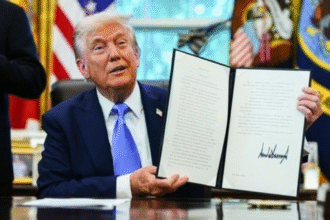
U.S. President Donald Trump has introduced a new policy imposing a US$100,000 fee for new H-1B visa applications, effective immediately. Existing H-1B visa holders and renewals are exempt, meaning the policy targets new applicants only. This move has significant implications for the Indian IT industry, which is heavily dependent on the U.S. market for revenue and talent mobility. India’s IT sector, valued at approximately $283 billion, derives around 57% of its revenue from the U.S., and last year, Indian workers accounted for 71% of approved H-1B visas.
The policy disrupts the traditional onsite delivery model, where Indian IT companies rotate skilled employees to client locations in the U.S. Firms are expected to restrict cross-border rotations, accelerate offshore delivery from India or other cost-efficient locations, and hire more U.S. citizens or green card holders for client-facing roles. H-1B sponsorship will likely be limited to critical roles, with firms becoming more selective about which employees qualify. In the short term, companies may face delays in project timelines, slower deal conversions, and re-scoping of contracts, while workforce planning—including travel and relocation—may experience disruptions. Margins could be pressured as firms adapt to a model emphasizing offshore delivery, automation, and onshore staffing.
The policy is also expected to accelerate growth in Global Capability Centers (GCCs), also known as captive offshore centers, which manage operations, R&D, finance, and other strategic functions. India, already a hub for GCCs, could see further expansion as companies shift more critical work offshore. Other nearshore locations like Canada, Mexico, and Latin America may also attract investment as U.S. firms look for talent closer to their time zones at lower costs.
Legal uncertainty surrounds the policy. Immigration lawyers expect challenges in court due to confusion over implementation details, such as which roles and companies will be affected. This comes amid other macro pressures on the sector, including weak U.S. revenue growth, inflation, tariffs, and a proposed 25% tax on outsourcing payments.
In the short term, the policy could disrupt hiring and operations, cause project delays, and create uncertainty around visa approvals. Over the medium-to-long term, the Indian IT sector may shift more work offshore, strengthen its GCC operations, invest in automation, and rebalance its talent deployment. U.S.-based operations may contract or change, with greater reliance on local hires for onsite functions and restructuring of cost and pricing models.
In conclusion, Trump’s H-1B visa fee represents a significant structural change for the Indian IT industry. While it may cause short-term operational challenges, it could accelerate a longer-term shift toward offshore delivery, GCC growth, and automation, reshaping how Indian IT firms manage talent and revenue from the U.S. market. Companies that adapt quickly will likely maintain competitiveness, while those heavily reliant on onsite H-1B staffing may face margin pressures and slower growth.