



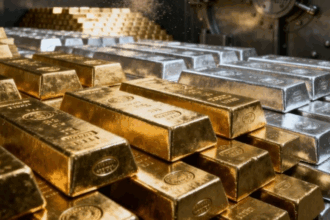
Gold and silver prices fell on Friday, bringing an end to a nearly nine-week winning streak. On the Multi Commodity Exchange of India (MCX), gold futures for the December contract dropped about 0.44% to ₹1,23,552 per 10 grams by 9:06 a.m. IST. Silver December contracts also saw a decline of around 0.98%, trading at ₹1,47,052 per kg. The drop in domestic metal prices follows a similar trend globally, reflecting broader market pressures and investor sentiment.
On the international market, spot gold fell by roughly 0.2% to $4,118.68 per ounce, while spot silver declined about 0.6% to $48.62 per ounce. The recent weakness in prices comes after a long rally, during which gold repeatedly hit record highs. Many traders chose to book profits, selling their holdings after the strong upward move. This was accompanied by heavy outflows from gold-backed ETFs, marking the largest single-day drop in five months, which further added to selling pressure.
One of the main reasons behind the dip is the strengthening U.S. dollar. As a result, demand from international buyers often slows down when the dollar rises, putting additional pressure on global metal prices. Moreover, market participants are keeping a close watch on the upcoming U.S. inflation (CPI) report. This report is expected to influence the Federal Reserve’s monetary policy, particularly interest-rate expectations, which can directly impact non-yielding assets such as gold.
Despite the recent fall, gold has been on a strong upward trajectory, rising more than 50% year-to-date. The metal’s rally has been supported by a combination of factors, including trade tensions between major economies and ongoing geopolitical risks, such as sanctions imposed on Russia. Analysts note that these factors have historically made gold an attractive safe-haven asset, especially during periods of uncertainty. However, if the global weak trend continues, MCX gold for the December contract could potentially dip further to around ₹1,23,000 per 10 grams.
For investors, the recent movement highlights a short-term correction phase in the gold market. While profit-taking has caused a temporary dip, long-term prospects remain robust. The U.S. inflation data continues to be a major market catalyst, as higher inflation may sustain demand for gold, while lower-than-expected figures could weigh on prices. In addition, fluctuations in the U.S. dollar and ETF flows remain important triggers for both domestic and international metal prices.
Silver, too, is following a similar pattern. Although it is down nearly 1% in MCX trading, silver has been supported over the year by rising industrial demand, global market trends, and safe-haven buying during periods of uncertainty. Traders and investors should remain cautious about short-term volatility while focusing on long-term trends, as metals like gold and silver historically provide a hedge against inflation and currency fluctuations.
Overall, while gold and silver have seen a short-term pullback, the long-term trend remains strong. Gold’s year-to-date gains of over 50% demonstrate continued investor confidence and the metal’s resilience amid global economic pressures. For traders, understanding factors such as currency movements, ETF flows, and global geopolitical risks can help navigate the market and plan strategies around profit-taking periods and short-term corrections.