Written By: Kaushal Sharma
Have you ever wondered why the same product costs different amounts in different countries? Why does a burger cost $5 in the U.S. but ₹400 in India? The reason lies in the differences in purchasing power between countries.

Written By: Kaushal Sharma
Have you ever wondered why the same product costs different amounts in different countries? Why does a burger cost $5 in the U.S. but ₹400 in India? The reason lies in the differences in purchasing power between countries.
Purchasing power parities (PPPs) are the rates of currency conversion that try to equalise the purchasing power of different currencies, by eliminating the differences in price levels between countries. The basket of goods and services priced is a sample of all those that are part of final expenditures: final consumption of households and government, fixed capital formation, and net exports. This indicator is measured in terms of national currency per US dollar.
According to this concept, two currencies are in equilibrium when their currencies are at par and a basket of goods is priced the same in both countries, taking into account the exchange rates.
PPP is widely used by economists, investors, and policymakers to:
- Compare living standards across countries.
- Determine if a currency is overvalued or undervalued.
- Predict long-term exchange rate movements.
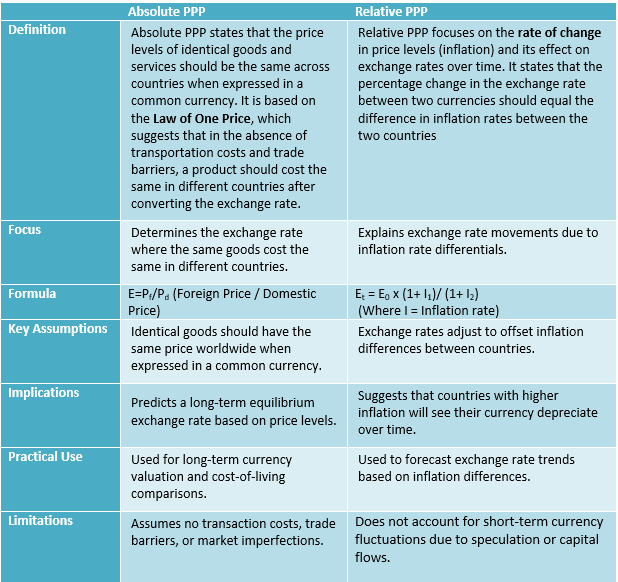
This form of PPP states that the price of an identical basket of goods should be the same across countries when converted to a common currency.
Example: The Big Mac Index
The Big Mac Index, developed by The Economist Pam Woodall, is a simple way to measure PPP. Since McDonald’s Big Mac is sold worldwide, its price is used to compare currency values.
If a Big Mac costs $5 in the U.S. and ₹400 in India, the PPP exchange rate should be:
Price in India/Price in U.S.= 400/5 = 80 INR/USD
If the actual exchange rate is ₹86 per USD, then the Indian Rupee is slightly undervalued compared to the U.S. dollar. Since ₹86 is weaker than ₹80, it means the rupee is undervalued compared to the PPP rate, If the actual exchange rate were stronger (e.g., ₹80/USD), then the rupee would be fairly valued.
The basic formula for Absolute PPP is:
E = P1/P2
Where:
- E = PPP-based exchange rate
- P1 = Price of a standard basket of goods in Country 1
- P2 = Price of the same basket in Country 2
Relative PPP considers inflation and suggests that exchange rates adjust over time to reflect changes in price levels between countries. The formula for relative PPP is:
Et = E0 x (1+ I1)/ (1+ I2)
Where:
- Et = Future exchange rate
- E0 = Current exchange rate
- I1, I2= Inflation rates of two countries
In simple terms, if inflation is higher in one country compared to another, its currency should depreciate over time to maintain parity. This theory assumes that differences in price levels are the primary driver of exchange rate movements. However, factors like interest rates, trade policies, and investor sentiment also influence exchange rates.
Example: A practical example of Relative Purchasing Power Parity (PPP) can be seen in the exchange rate movement between the US Dollar (USD) and Indian Rupee (INR) over time.
Scenario:
- Suppose in 2020, the exchange rate was 1 USD = 75 INR.
- The inflation rate in the U.S. was 2%, while in India, it was 6%.
Application: Et= E0 x (1+I1)/(1+I2)
Et = 75 x (1+6%)/(1+2%)
Et = 75 x 1.06/1.02 = 77.94
According to Relative PPP, due to India’s higher inflation, the INR should depreciate against the USD, leading to an expected exchange rate of 1 USD = 77.94 INR.
PPP is used by organizations like the International Monetary Fund (IMF), World Bank, and OECD to compare economic output between countries. It helps adjust GDP figures to reflect the actual purchasing power of citizens.
Example: India’s GDP might seem lower than the U.S. in dollar terms, but when adjusted for PPP, India’s economy appears much larger due to lower costs of living.
By comparing the price of the same product worldwide, we can determine if a country’s currency is undervalued or overvalued. This helps in foreign exchange decisions.
Example: If the Big Mac costs more in Japan than in the U.S., the Japanese Yen might be overvalued.
PPP helps investors and businesses predict long-term trends in currency movements. If a currency is significantly undervalued, it may appreciate in the future.
Some forex traders use PPP to find potentially overvalued or undervalued currencies. Investors who hold stocks or bonds of foreign companies may use PPP figures to predict the impact of exchange rate fluctuations on a country's economy, and thus on their investment.
PPP is a crucial tool for comparing economic productivity and determining whether a currency is undervalued or overvalued. It is widely used by economists, investors, and policymakers to make informed decisions.
However, real-world exchange rates do not always align with PPP predictions due to:
- Trade restrictions and tariffs
- Differences in consumer behaviour
- Non-tradable goods
- Short-term economic fluctuations
Thus, while PPP provides valuable insights, it should be used alongside other economic indicators for accurate currency and economic analysis.
While PPP is a useful tool for economic comparison, it has several limitations that prevent exchange rates from aligning perfectly with PPP predictions:
What do you think of “Purchasing Power Parity”?


Comments
Log in to comment and join the discussion.
No comments yet. Be the first to comment.