




Research By: Dhruv Gupta
In the world of investing, investors and analysts often speak of the “intrinsic value” of a stock, a concept that lies at the heart of value investing. It is a measure of what a stock is truly worth, based on fundamental analysis, rather than its current market price. In this blog post, we’ll explore the concept of intrinsic value, how to calculate it, and why it matters in investment decisions.
What Is Intrinsic Value?
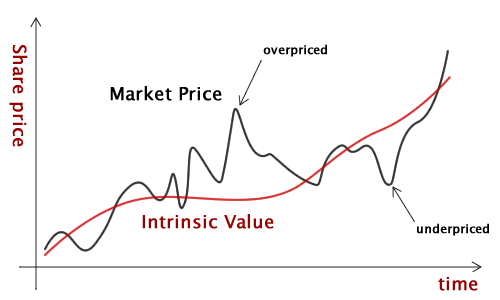
Intrinsic value refers to the perceived or calculated value of a stock, based on its fundamentals. Unlike the market price, which is influenced by supply and demand dynamics, investor sentiment, and market trends, intrinsic value focuses on the actual worth of a company. This value is determined by analyzing financial statements, understanding the business model, assessing growth potential, and considering macroeconomic factors.
The goal is to determine whether a stock is undervalued (trading below its intrinsic value) or overvalued (trading above its intrinsic value). This assessment helps investors make informed decisions about buying, holding, or selling a stock.

Why is intrinsic value useful?
The essence of value investing is to identify stocks that are trading below their intrinsic value, offering opportunities for potentially profitable investments. Relying solely on current stock prices might be misleading, as they don’t fully capture an asset’s true worth. By focusing on intrinsic value, investors can uncover the genuine value of a stock.
Methods to Calculate Intrinsic Value
- Discounted Cash Flow (DCF) Analysis:
- DCF is one of the most widely used methods for calculating intrinsic value. It involves estimating the company’s future cash flows and discounting them back to their present value using an appropriate discount rate. The formula is as follow

Where r is the discount rate(WACC) and n is the number of periods.
- Dividend Discount Model (DDM):
- This model is primarily used for companies that pay dividends. The intrinsic value is calculated by discounting future dividend payments back to their present value. The basic formula is:
- This model is particularly useful for valuing mature companies with a stable dividend history.
- This model is primarily used for companies that pay dividends. The intrinsic value is calculated by discounting future dividend payments back to their present value. The basic formula is:
- Price-to-Earnings (P/E) Ratio:
- While not a direct calculation of intrinsic value, the P/E ratio can provide insights when compared to the company’s growth rate. By comparing a company’s P/E ratio to that of its peers or the broader market, investors can infer whether a stock is undervalued or overvalued.

Key Drivers of Intrinsic Value
- Revenue and Profitability:
- The core of a company’s value lies in its ability to generate profits. Investors assess both historical earnings and future earnings potential to understand the company’s profitability. A consistent track record of earnings growth often signals a healthy business.
- Cash Flow:
- Free cash flow (FCF) is a critical metric for determining intrinsic value. It represents the cash a company generates after accounting for capital expenditures. Companies with strong, stable cash flows are typically more valuable because they have the financial flexibility to invest in growth opportunities, pay dividends, and reduce debt.
- Growth Potential:
- A company’s future growth prospects are critical in determining its intrinsic value. This includes factors like market expansion, innovation, competitive positioning, and the overall industry growth rate.
- Risk Assessment:
- Higher risk typically reduces intrinsic value, as investors demand a higher return to compensate.
- Discount Rate:
- The discount rate is used to convert future cash flows into present value. It reflects the time value of money and the risk associated with the investment. A higher discount rate reduces the present value of future cash flows, thereby lowering the intrinsic value of the stock.
Challenges in Determining Intrinsic Value
Calculating the intrinsic value of a stock is not without its challenges:
Intrinsic value calculations can be complex, requiring a deep understanding of financial modeling, industry dynamics, and economic conditions. Different analysts may use different models or inputs, leading to varying estimates of intrinsic value.
Uncertainty in Projections:
Estimating future earnings, cash flows, and growth rates involves a degree of subjectivity. Different analysts may arrive at different intrinsic values based on their assumptions and interpretations of data.
Market Discrepancies:
The market price of a stock can deviate significantly from its intrinsic value due to short-term factors like investor sentiment, economic news, or market speculation. These deviations can persist, making it difficult to rely solely on intrinsic value for timing investment decisions.
Complexity and Subjectivity:
Intrinsic value calculations can be complex, requiring a deep understanding of financial modeling, industry dynamics, and economic conditions. Different analysts may use different models or inputs, leading to varying estimates of intrinsic value.