




Written By: Saiyam Sondhi
Let’s say your childhood friend Arjun has always dreamed of opening his own café. He saves for years, quits his safe IT job, borrows a bit from his uncle, and sets up a warm little coffee shop in the heart of the city.
On day one, business is slow. But soon, word spreads. People love his cappuccinos and homemade cookies. Within the first year, he crosses ₹12 lakh in sales. By the second year, sales double to ₹25 lakh. Local college kids flock in, the Instagram page blows up, and Arjun decides it’s time to think big.
He takes another loan, hires more staff, expands the menu. He introduces live music nights, runs crazy discounts to pull in bigger crowds, and starts offering free Wi-Fi and endless refills. The café is buzzing. Friends and family keep telling him, “Look at your sales! Next stop: franchise!”
But while the tables stay full, Arjun’s cash register tells a different story. Electricity bills shoot up. His barista team wants higher wages. The food supplier raises prices. Freebies eat into margins. That new acoustic band charges more than he thought. The EMI for the new espresso machine hits every month, whether customers come or not.
By the end of year three, sales have crossed ₹50 lakh, but the profit is gone. Actually, worse, he owes more than he makes. One bad month, a festival where everyone leaves town, and he misses supplier payments. The landlord wants rent. His staff leaves for steadier jobs. Arjun’s café, once packed with people, quietly shutters with debts still unpaid.
The Illusion of Big Sales
High sales growth is thrilling. Every entrepreneur wants to see that chart line shoot up, more customers, more noise, more excitement. But sales alone are only half the story.
If you only look at how much money is coming in, you might miss how much is leaking out. A business can double its sales by throwing freebies, running discounts, and borrowing to expand faster than it should , but underneath, the costs keep rising too. If profit margins shrink, or debt piles up to keep the growth alive, then that bright sales chart is just sugarcoating trouble.
Good Growth vs. Bad Growth: The Supermarket Test
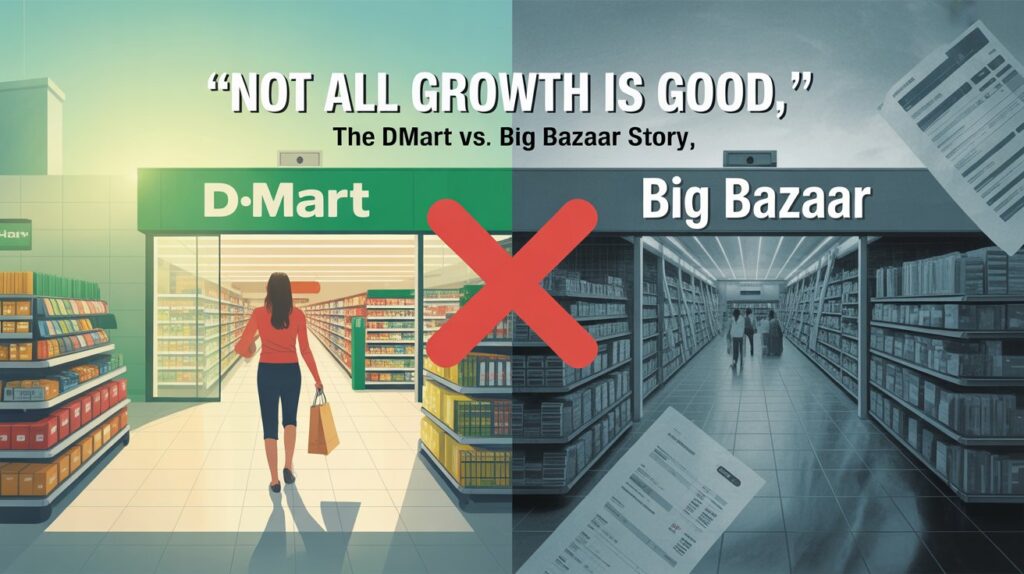
To see how this plays out in the real world, let’s look at two Indian retail giants that almost everyone knows: DMart and Future Retail (Big Bazaar).
DMart is like that sensible shopkeeper you trust. They didn’t throw wild discounts to chase headlines. They built stores carefully, one neighborhood at a time, in places where people actually shop for daily needs. They squeezed costs tight, negotiated hard with suppliers, and used the profits from each store to open the next one. No fancy ads, no celebrity endorsements, no ballooning debt.
In FY23, DMart clocked over ₹42,800 crore in sales. But the real magic? They did it while keeping a healthy profit margin, roughly 5% net profit, which is rare in big-box retail. Their debt? Tiny compared to peers. So every rupee they earn mostly stays inside the business, fueling steady expansion.
Now compare that with Future Retail, the owner of Big Bazaar. For years, Big Bazaar was everywhere. Malls, high streets, you name it, they put a store there. Sales soared past ₹20,000 crore by FY19. On paper, it looked unstoppable. But underneath, the engine was leaking oil.
They expanded aggressively but with thin margins, around 3.6% net profit. To keep opening new stores, they borrowed heavily. As debt climbed into thousands of crores, their cash flow got squeezed. Bills to suppliers and landlords started piling up.
Then came COVID. Footfalls vanished. Rent and loan repayments did not. Overnight, Big Bazaar’s vast store network turned from a dream to a liability. When the cushion is debt and the profits are thin, one shock is enough to crack the floor.
Think of It Like a Restaurant
A business chasing only high sales is like a busy restaurant that fills every seat by giving away half the food for free. Sure, people queue up outside. The buzz is real. But what’s the use if each plate sold loses ₹10? The busier they get, the faster they sink.
Good growth is like a smart, busy dhaba that never compromises its recipes just to attract a bigger crowd. It doesn’t offer free meals to pack the tables, it keeps prices fair, quality high, costs tight. Every extra plate served brings in real money that pays the staff, the rent, and leaves enough to expand or fix what’s broken.
What Smart Investors Should Watch

When you see a company’s sales numbers double overnight, don’t clap just yet. Ask: Are they making more profit per sale? Is their debt rising or shrinking? Are they borrowing to grow or using cash flows?
Look for the signs:
– Are margins stable or falling?
– Are they offering steep discounts that eat into profit?
– Is debt climbing faster than profit?
– Do suppliers get paid on time?
– Do they grow by adding stores or just by cutting prices?
The best businesses turn every new sale into more profit, not more drama.
The Real Question
Big sales make nice headlines and loud social media posts. But the bottom line keeps the lights on when the party’s over. If you want to understand whether a company’s growth is healthy, ask this one simple question:
“Are they filling seats with real profit, or just feeding everyone free cake to look busy?”
Because when the free cake runs out, or when a rainy day comes only real profits pay the rent.
Next time you see a company bragging about explosive sales growth, smile, then check the kitchen.
If the cash register is empty, the party won’t last long.