



Research By: Keshav Kumar
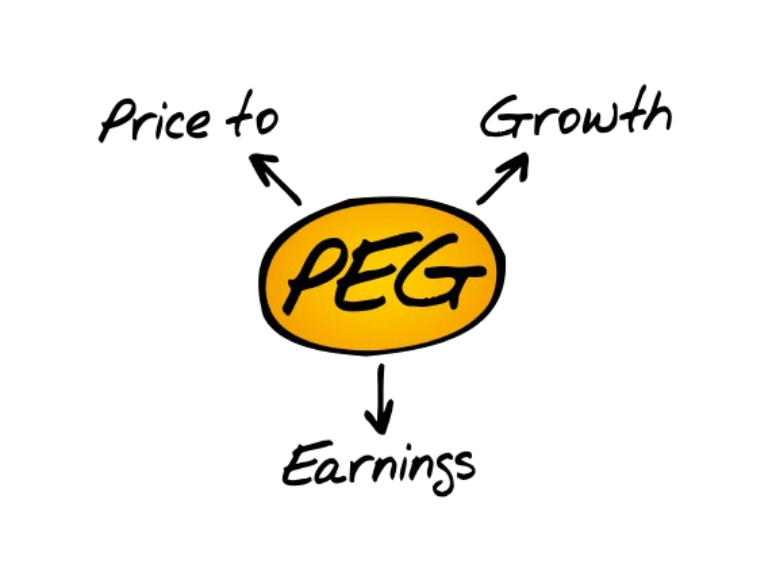
The P/E ratio, or Price-to-Earnings Ratio, is a well-known tool in fundamental analysis that measures how the market values a company’s stock relative to its earnings. It is calculated by dividing the current share price by the earnings per share (EPS). Another related metric is the Price/Earnings-to-Growth (PEG) ratio, which builds on the P/E ratio by incorporating the company’s expected earnings growth rate. This allows investors to assess the stock’s valuation while considering its potential for future growth.
How is the PEG Ratio Calculated?
Step 1: Calculate the P/E Ratio
To calculate the PEG ratio, it’s essential first to determine the Price/Earnings (P/E) ratio, which uses trailing Earnings Per Share (EPS) — that is, the EPS from the previous 12 months or more. The forward P/E ratio is not applicable in this calculation. Here’s how you compute the trailing P/E ratio for a stock:
Trailing P/E Ratio = Current Price Per Share / Trailing EPS for the past 12 months
Step 2: Find the Earnings Growth Rate
The second element is the Earnings Growth Rate, which introduces a future-oriented aspect to the PEG ratio. Typically shown as an annual percentage, this rate can be sourced from a company’s financial reports, analyst evaluations, or investor relations pages.
It’s crucial to ensure that the Earnings Growth Rate matches the time frame of the EPS used in the P/E ratio calculation to maintain consistency.
After determining the P/E ratio and obtaining Earnings Growth Rate you can easily find the Price/Earnings-to-Growth (PEG) ratio by applying this formula:
PEG Ratio = P/E Ratio / EPS Growth Rate
The formula above can also be detailed further as:
PEG Ratio = (Current Price Per Share / Trailing EPS) / EPS Growth Rate
What Does It Reveals?

The PEG ratio evaluates a stock’s price relative to its expected profit growth, providing a growth-oriented perspective beyond the traditional P/E ratio.
For example, stock A has a P/E ratio of 20 and a growth rate of 18%, resulting in a PEG ratio of 1.11. Stock B, with a P/E ratio of 25 and a 30% growth rate, has a PEG ratio of 0.83. Although stock A has a lower P/E ratio, its higher PEG ratio suggests it is overvalued compared to its growth potential.
Conversely, stock B, with a higher P/E ratio, appears undervalued when future growth is considered. A PEG ratio of 1 indicates a balanced valuation, while ratios above 1 suggest overvaluation and those below 1 indicate undervaluation. It’s essential to interpret PEG ratios within the context of the industry and market conditions.
Advantages of the PEG Ratio
1)Comprehensive Solution– The ratio provides a thorough and integrated perspective on a company’s stock growth. In contrast to the P/E ratio, it takes into account the stock’s future growth potential. By integrating the P/E ratio with growth expectations, it gives investors a fuller understanding, enabling them to assess the stock’s growth prospects and make well-informed investment decisions.
2)Quick Insights– Investors can use this ratio to find stocks with strong growth potential and quickly dismiss those with weak future prospects.
3) Identifying Undervalued Stocks– Undervalued stocks can be promising investments with significant growth potential. The PEG ratio helps identify these opportunities by comparing companies and factoring in growth potential, making it useful for uncovering undervalued stocks with strong future prospects.
Disadvantages of the PEG Ratio
1)Reliance on Future Projections– The PEG ratio’s accuracy hinges on precise earnings growth forecasts. If these projections are incorrect, it can lead to flawed valuations and poor investment choices. Investors must be aware of the potential uncertainty in predicting future growth, as inaccuracies can significantly impact the PEG ratio.
2) Overlooks Company-Specific Factors– The PEG ratio fails to account for important company-specific factors such as management quality and competitive advantages. Relying solely on the PEG ratio can lead to misjudgments and potentially poor investment decisions, as it ignores unique aspects of each company.