



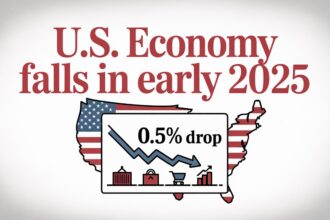
The U.S. economy got smaller by 0.5% in the first three months of 2025. This is based on the final report from the Bureau of Economic Analysis, released on June 26, 2025. Earlier, experts thought the economy would fall by just 0.2%, but the new number shows a bigger slowdown. In the previous quarter (October to December 2024), the economy had grown by 2.4%, so this drop was a big change.
There were a few main reasons for this decline. First, imports increased a lot—by over 37–42%. Companies bought more goods from other countries before new tariffs (extra taxes) were expected. But in GDP, imports are counted as a negative, so this large increase pulled the number down by almost 4.7 to 4.9 percentage points.
Second, the U.S. government spent less money during this time. Federal spending dropped by 4.6%, which made the slowdown worse.
The most worrying part was that consumer spending, which is the most important part of the economy, grew very slowly. People spent only 0.5% more, much less than the 4% increase in the previous quarter. Both spending on goods and services went down, showing that many people were careful with money.
There was some good news too. Businesses invested more, with investment rising 7.8%, and inventories (unsold goods) increased, which helped stop the economy from falling even more.
However, inflation is still high. The core PCE inflation—which the Federal Reserve watches closely—was 3.5%, and the overall PCE index was 3.7%. At the same time, the Gross Domestic Income (GDI), which measures income in the economy, grew by 0.2%. This means incomes did a little better than spending.
This mix of slow growth and high prices makes it hard for the Federal Reserve (the U.S. central bank) to make decisions. Normally, when growth slows, the Fed might cut interest rates. But because inflation is still high, they may wait. Fed Chair Jerome Powell has said that the Fed needs to see more data before changing interest rates.
Financial markets reacted carefully. U.S. government bond yields fell, the U.S. dollar got weaker, and stock prices were mixed. Sectors like utilities went up, but consumer and industrial stocks went down because of worries about spending and trade.
Looking ahead, experts expect better numbers in the next quarter (April to June 2025). The Atlanta Fed thinks growth will be around 3.4%, and other forecasts suggest about 3% growth. But this depends on things like import levels going back to normal, how confident consumers feel, and when the Fed might cut interest rates.
To sum it up: The 0.5% drop in the U.S. economy in Q1 2025 shows a short-term slowdown, caused by too many imports, less government spending, and low consumer activity. Still, strong business investment and steady jobs are helping to avoid a bigger problem. A recovery is expected soon—if key trends improve.