



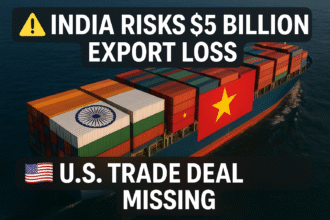
India may lose as much as $5 billion in exports to Vietnam if it does not get a new trade agreement with the United States. Right now, India exports around $76 billion worth of goods to the U.S. every year. But India and Vietnam both sell similar products to the U.S., and they compete directly in over 160 items worth about $22 billion in trade.
According to a report, around $5.4 billion of this trade is at risk. These are products where Vietnam could easily replace India, especially if the U.S. gives Vietnam better trade terms. A smaller group of products worth $353 million are especially at risk — they are price-sensitive and easily replaceable.
The reason for this risk is a new trade deal between the U.S. and Vietnam. Under this deal:
– A 20% tariff is set on genuine Vietnamese goods.
– A higher 40% tariff is placed on trans-shipped goods (products passed through Vietnam but made elsewhere).
If India does not sign a similar deal, Vietnam’s products will look cheaper and more attractive in the U.S. market. This could lead to India losing customers in key areas like apparel, seafood, and furniture.
Experts from the Global Trade Research Initiative (GTRI) have said that India should pay attention to how Vietnam’s deal works—especially the rules that check whether goods are really made in Vietnam. These rules matter because they can affect fair competition.
There are some opportunities for India. If Vietnam’s low-cost edge fades due to origin checks or other limits, Indian goods in some industries may benefit. But without a U.S. deal, India’s exporters still face big risks.
Talks between India and the U.S. have stalled. Disagreements remain over tariffs on steel, cars, agriculture, and medicine. With a July 9 deadline approaching for possible tariff increases, India has limited time to protect its interests.
The U.S.–Vietnam deal now acts as a model. It offers lower tariffs for trusted goods but higher ones for doubtful ones. India must now either match this deal or build its own, or else risk being left behind.
To avoid this, India should speed up trade talks and maybe even go for sector-specific deals to protect its most affected industries.