





The global financial landscape has been influenced by the rising bond yields in the United States. The current US bond yield stands at 5.5%, offering investors a safe and predictable return. This high yield, combined with the dollar appreciating by 3% against the Indian Rupee (INR), has shifted the preferences of many foreign institutional investors (FIIs).
In contrast, the Indian equity market is struggling with high valuations. These valuations are not perceived as attractive enough to compensate for the returns provided by US bonds. For FIIs, the equation is straightforward. A safe return of 8.5% is available, accounting for the bond yield and dollar appreciation. For them to consider the Indian market, an annual return of 15-20% would likely be required to justify the risk and effort involved in moving capital to India.
Until the US bond yields fall to the range of 1-2%, or the Indian equity market adjusts to offer more compelling returns, FIIs are expected to continue withdrawing funds from the Indian market. This withdrawal can create pressure on Indian equities, particularly in sectors where FIIs have historically had a strong presence.

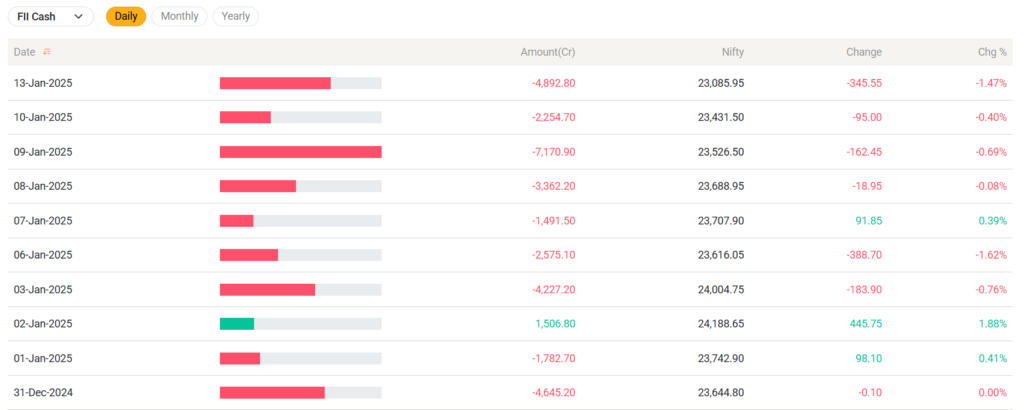
Source: Research 360
Domestic institutional investors (DIIs) have played a stabilizing role in the market during periods of FII outflows. However, it may not be sustainable for DIIs to continue propping up the market while FIIs are actively exiting. Instead, it may be more strategic for DIIs to hold back during such times and wait for more favorable opportunities to make bulk purchases. By doing so, DIIs could potentially acquire assets at lower valuations, which may enhance returns in the long run.
The interplay between FII outflows, DII strategies, and the broader macroeconomic environment will remain crucial for the Indian equity market. Investors will be closely watching for signs of shifts in global bond yields or domestic market conditions that could alter these dynamics. For now, the high returns available in US bonds and the valuation levels in India suggest that the current trend of FII outflows may persist.