



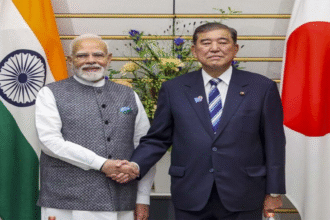
Japan has pledged a massive ¥10 trillion (~US$68 billion) investment in India over the next decade, doubling its earlier target of ¥5 trillion by 2026, already achieved ahead of schedule. The announcement came during the 15th India–Japan Annual Summit in Tokyo, where Prime Ministers Narendra Modi and Shigeru Ishiba unveiled a comprehensive 10-year roadmap for deepening strategic and economic cooperation.
The investment plan spans critical areas including economic security, innovation, health, clean energy, mobility, and people-to-people exchanges. A major highlight is the launch of the Economic Security Cooperation Initiative, designed to strengthen semiconductor manufacturing, secure critical mineral supply chains, and boost AI and digital infrastructure development. Clean energy is a key focus, with collaboration on hydrogen and ammonia technologies to accelerate India’s green transition.
Defense ties are also receiving a significant upgrade, with agreements on joint innovation, enhanced maritime security coordination, and potential collaboration on space exploration, including India’s Chandrayaan-5 mission with Japan’s JAXA. Infrastructure remains a priority with continued support for the Mumbai–Ahmedabad bullet train project, featuring Japan’s E10 Shinkansen technology.
Human capital exchange is central to the partnership. Japan will facilitate the mobility of 50,000 Indian skilled workers over five years, alongside a larger goal of 500,000 total exchanges, strengthening cultural and professional ties between the two nations.
This renewed push comes at a crucial time, as India–U.S. trade relations face friction with Washington imposing 50% tariffs on Indian exports over Russian oil imports. The India–Japan investment roadmap signals New Delhi’s strategy to diversify partnerships, enhance supply chain resilience, and attract long-term foreign capital despite global uncertainty. Experts view this as a vote of confidence in India’s growth story, particularly in manufacturing, clean tech, mobility solutions, and digital infrastructure.
For investors, the message is clear: India–Japan ties are entering a high-growth phase driven by technology transfer, industrial collaboration, and policy support. This creates opportunities across semiconductors, AI, renewable energy, infrastructure, and MSMEs, sectors expected to power India’s next decade of economic expansion.