




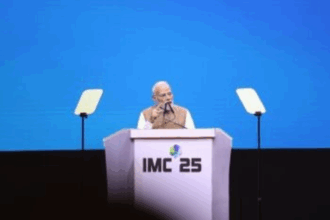
At the India Mobile Congress (IMC) 2025, Union Communications Minister Jyotiraditya Scindia emphasized that digital connectivity in India is no longer a luxury, but a fundamental necessity. Speaking at the International 6G Symposium, he highlighted India’s ambition to not just adopt technology, but become an “architect” of it. According to Scindia, India’s push on 6G could contribute up to $1.2 trillion to the country’s GDP by 2035.
India’s telecom journey over the past decade has been remarkable. Mobile data costs have dropped from ₹287 per GB in 2014 to just ₹9.11 per GB today, and the country now boasts 1.2 billion mobile subscribers, nearly 20% of the world’s mobile population. Broadband subscriptions have surged from 60 million to 944 million, while mobile phone manufacturing has grown 28×, electronics production 6×, and exports in key telecom segments 127× since 2014.
Scindia also spoke about domestic technology and infrastructure development, including the launch of an indigenous 4G stack and installation of 100,000 towers using this homegrown technology. He asserted that this Made-in-India 4G stack is ready for export, and the domestic semiconductor industry is growing under the PLI scheme, reaching ₹91,000 crore in production. The Bharat 6G Alliance aims to secure 10% of global patents in this emerging technology, positioning India to lead globally in next-generation connectivity.
Prime Minister Narendra Modi reinforced this vision, stating that India’s democratic values, investor-friendly policies, and ease of doing business make it an ideal time to invest and innovate. He noted the massive growth in manufacturing, electronics, and exports, and highlighted the deployment of 1 lakh towers as a demonstration of India’s capability to scale infrastructure. Modi stressed that India should expand beyond device assembly into chipsets and electronics components.
Other stakeholders also contributed perspectives. Gopal Vittal, MD of Bharti Airtel, highlighted the importance of trust, security, and inclusive digital regulation, pointing out the growing threat of scams and cybercrime. Akash Ambani of Reliance Jio applauded PM Modi’s leadership and noted India’s growing ecosystem in AI, semiconductors, fraud prevention, and 6G. MoS Pemmasani Chandra Sekhar said innovation has shifted from a niche activity to a collective national mission, driven by government leadership over the past decade.
The Ministry of Electronics and IT (MeitY) also updated that applications for the capital equipment segment under the Electronics Component Manufacturing Scheme (ECMS) remain open, signaling ongoing government support for domestic innovation and manufacturing.
IMC 2025, Asia’s largest telecom and tech forum, draws over 1.5 lakh visitors from 150+ countries, 400+ companies, and showcases 1,600+ use cases across 5G, 6G, AI, smart mobility, cybersecurity, quantum, and green tech. The event hosts over 100 sessions with 800 speakers and international delegations from Japan, Canada, UK, Russia, Ireland, and Austria, highlighting India’s growing global role in technology.
Key themes emerging from the congress include self-reliance through indigenous innovation, global leadership in 6G, large-scale infrastructure development, trust and regulatory frameworks, and an inclusive technology ecosystem. Collectively, these efforts demonstrate that India is transforming connectivity from a privilege into a strategic, accessible, and economically significant resource.