


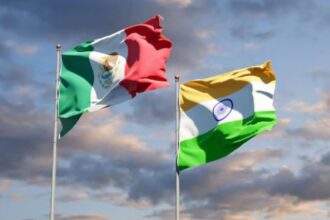
India has formally begun discussions with Mexico to negotiate a Preferential Trade Agreement (PTA), following a sharp increase in import tariffs imposed by Mexico on countries that do not have a Free Trade Agreement (FTA) with it. According to The Financial Express, this move is aimed at protecting Indian exporters who are expected to face higher duties starting January 1, 2026.
Mexico recently approved higher import tariffs ranging from 5% to 50% on goods imported from non-FTA partners, including India. These tariff hikes have been implemented within the World Trade Organization (WTO) framework, meaning they fall under Mexico’s committed tariff ceilings and therefore cannot be legally challenged at the WTO. This has left India with limited options to counter the impact, prompting it to pursue a trade agreement-based solution.
India views a Preferential Trade Agreement as the fastest and most practical route to provide relief to affected exporters. Unlike a full Free Trade Agreement, which typically takes several years to negotiate and finalise, a PTA allows countries to offer selective tariff concessions on specific goods in a much shorter time frame. Indian officials believe this approach can help stabilise supply chains and reduce immediate trade disruptions.
Explaining India’s position, Commerce Secretary Rajesh Agrawal said that proposing a PTA is a WTO compatible solution to manage the tariff shock. He noted that India is also open to exploring mutual concessions, especially in areas where Mexico has export interests in the Indian market. This reciprocal approach is expected to make the negotiations more balanced and commercially viable for both sides.
Diplomatic engagement between the two countries has been active over the past few months. India’s Embassy in Mexico first raised concerns with Mexico’s Ministry of Economy on September 30, 2025, highlighting the potential impact of the tariff increases on Indian businesses. This was followed by a virtual meeting on December 2, 2025, between India’s Commerce Secretary and Mexico’s Vice Minister, where both sides agreed to pursue a trade agreement to address the issue swiftly. Technical level discussions on the PTA have been underway since December 12, 2025.
The trade relationship between India and Mexico has grown steadily in recent years. In 2024–25, India’s exports to Mexico stood at around $5.75 billion, while imports were approximately $3.01 billion, giving India a trade surplus of $2.72 billion. Officials estimate that Mexico’s new tariff regime could impact nearly $2 billion worth of Indian exports, making the issue economically significant.
Several key sectors are likely to be affected by the higher tariffs. These include automobiles and two-wheelers, auto components, textiles, iron and steel, plastics, and leather and footwear. These industries form a major share of India’s exports to Mexico and are closely integrated into cross-border supply chains.
Beyond trade in goods, bilateral investments also play an important role in the relationship. Around 200 Indian companies operate in Mexico, with total investments estimated at $4 billion. Changes in tariff structures could therefore have a wider impact on ongoing business operations and long-term investment decisions.
Overall, the PTA talks aim to secure tariff concessions, ensure greater trade stability, and protect established supply chains, while staying within WTO rules. While not a substitute for a full FTA, the proposed agreement is seen as a pragmatic and timely response to evolving global trade conditions.