




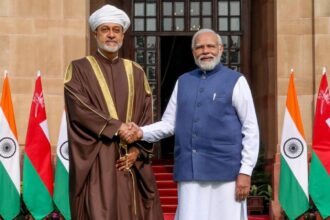
Prime Minister Narendra Modi hailed the India‑Oman Comprehensive Economic Partnership Agreement (CEPA) as a transformative milestone during the India‑Oman Business Summit in Muscat on December 18, 2025. The summit underscored the strengthening of strategic and economic ties between India and Oman, with the CEPA set to reshape bilateral trade, investment flows, and regional collaboration. The Comprehensive Economic Partnership Agreement (CEPA) is a modern free trade pact that goes beyond mere tariff reductions, covering goods, services, investment, rules of origin, customs cooperation, and regulatory harmonization, creating a framework for deeper economic integration. India and Oman have finalized the CEPA and are preparing to sign and implement it, marking a new chapter in bilateral trade relations.
During the summit, PM Modi described the India‑Oman CEPA as a “blueprint of our shared future”, emphasizing its potential to boost trade, attract investment, and create business opportunities across multiple sectors. He highlighted that the agreement builds on centuries-old maritime trading links, with the Arabian Sea historically serving as a bridge of commerce and friendship. The CEPA aims to take bilateral ties to “new heights”, enabling startups, investors, and businesses from both nations to innovate, expand, and collaborate. The Prime Minister also stressed the CEPA’s role in enhancing private-sector participation, inviting companies to explore opportunities in sectors such as textiles, machinery, chemicals, logistics, tourism, education, and professional services, aligning with India’s broader strategy to strengthen economic diplomacy in the Gulf region and secure deeper market access for Indian exporters.
The economic significance of the India‑Oman CEPA is considerable. Trade expansion will be facilitated through tariff reductions across a wide range of goods, making it easier and more cost-effective for Indian products to enter the Omani market, particularly in sectors like textiles, machinery, chemicals, and engineering goods. Services and investment liberalization will enhance collaboration in logistics, professional services, and tourism, while Oman’s strategic position as a gateway to the Gulf and broader Middle East will help India strengthen regional trade networks. Bilateral trade, which stood at approximately $10.5–$10.6 billion in FY 2024‑25, is expected to grow significantly under the CEPA. The agreement also encourages mutual investments, with India already being one of Oman’s top trading partners and investors, while Oman supplies energy and petrochemical inputs crucial to India’s industrial sector.
Economists and trade analysts consider the CEPA a landmark agreement with long-term implications for India‑Oman economic relations. By combining trade facilitation, investment growth, and enhanced business engagement, the pact is expected to encourage cross-border joint ventures and capital flows, expand India’s export footprint in the Gulf region, and support broader economic integration with the Middle East, strengthening India’s strategic influence. In essence, PM Modi positioned the CEPA as a historic turning point, signaling a future of sustainable trade, investment, and bilateral cooperation. By modernizing trade rules, simplifying regulatory frameworks, and fostering business participation, India and Oman aim to achieve long-term economic prosperity and a robust strategic partnership.