



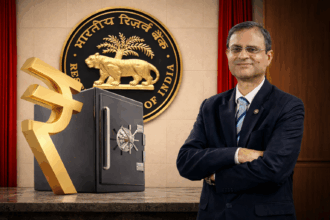
The Reserve Bank of India (RBI) on December 23, 2025, unveiled a major liquidity support program aimed at easing cash shortages in the Indian banking system and ensuring smooth functioning of financial markets. This announcement comes amid tightening liquidity conditions, which had pushed short-term interest rates higher and constrained normal bank lending. By injecting durable liquidity, the RBI seeks to stabilize money markets, support credit growth, and lower borrowing costs for businesses and consumers.
Under the program, the RBI will purchase government securities worth ₹2,00,000 crore through Open Market Operations (OMO). These purchases will be conducted in four equal tranches of ₹50,000 crore each on December 29, 2025, January 5, January 12, and January 22, 2026. OMO purchases directly inject cash into the banking system, increasing liquidity, improving interest rate transmission, and supporting short-term money market stability. The move reflects the RBI’s proactive approach to managing systemic liquidity and maintaining confidence in Indian financial markets.
Alongside bond purchases, the RBI will conduct a $10 billion USD/INR buy-sell swap auction with a three-year tenor, scheduled for January 13, 2026. In this forex swap operation, banks sell US dollars to the RBI in exchange for rupees and agree to repurchase the dollars later at a predetermined price. This temporarily increases rupee liquidity in the banking system while helping the RBI manage foreign exchange flows and stabilize the USD/INR currency market.
This latest announcement follows recent RBI measures, including OMO purchases of ₹1 lakh crore and a $5 billion dollar-rupee swap. The continuation of these actions suggests that liquidity conditions remain tight, prompting the central bank to step up support for the banking sector, financial institutions, and overall economic activity.
The practical impact of these measures is significant. For banks, additional liquidity allows them to meet short-term funding needs, maintain credit availability, and continue lending to corporates, MSMEs, and retail borrowers. For the bond market, increased liquidity may lower yields, reduce borrowing costs, and improve market confidence. For the broader economy, easier liquidity can enhance credit growth, stimulate business investments, and ensure smoother transmission of monetary policy.
The RBI’s ₹2 lakh crore liquidity infusion and the $10 billion USD/INR swap reflect its commitment to maintaining financial stability, supporting Indian banks, and fostering a robust economic environment. By combining OMO operations with forex interventions, the central bank addresses both domestic liquidity pressures and external sector considerations, reinforcing its role as a key stabilizer in India’s financial and economic system.