



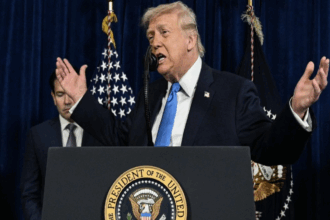
U.S. President Donald Trump has indicated that he is inclined to keep ExxonMobil out of Venezuela’s oil industry, following recent discussions with top executives from major U.S. oil companies. The announcement comes after ExxonMobil’s CEO Darren Woods expressed caution about investing in Venezuela, highlighting significant legal, commercial, and operational risks in the country’s oil sector. Trump reportedly criticized the company’s stance, saying that Exxon was “playing cute,” reflecting a tension between U.S. geopolitical strategy and corporate risk management in global oil investments.
ExxonMobil has historically faced challenges in Venezuela, a nation that possesses one of the largest proven oil reserves in the world. Woods cited the legal and economic instability, past nationalization of assets, and weak investment security frameworks as key reasons for the company’s reluctance. These factors make Venezuela “uninvestable” under current conditions, according to Woods. Legal reforms, restructuring of hydrocarbon laws, and stronger protections for foreign oil companies would be required to make investments viable. Past incidents, including asset seizures and disrupted production agreements, have made major U.S. and international oil companies wary of committing large-scale capital.
Trump’s reaction was firm, suggesting that ExxonMobil’s cautious position could affect its eligibility to participate in Venezuelan oil projects. The President emphasized the strategic importance of U.S. investment in Venezuela and indicated that American companies should act decisively to capitalize on opportunities in the country. This aligns with the administration’s broader goal of attracting U.S. oil investment to revitalize Venezuela’s declining oil production, which has suffered from years of underinvestment, sanctions, and political instability.
The Trump administration has taken steps to facilitate U.S. involvement in Venezuela’s energy sector, including signing an executive order to ensure that oil revenues are appropriately protected. This order signals a government-controlled approach to investment, offering companies assurances they would interact with U.S. authorities rather than Venezuela’s government. The aim is to provide clearer commercial terms and reduce the political and legal risks associated with Venezuelan oil development.
Despite these assurances, the story highlights a deeper tension between geopolitical objectives and corporate decision-making. U.S. policymakers are focused on leveraging Venezuela’s oil reserves to enhance global energy flows, support American energy security, and strengthen economic ties in the region. In contrast, ExxonMobil evaluates investments based on risk assessment, long-term profitability, asset security, and legal certainty. The misalignment between government ambitions and corporate caution underscores the challenges of reconciling energy diplomacy with private sector investment strategy.
The implications of Trump’s position are significant. Economically, Venezuela’s oil reserves could reshape global crude supply, influence oil prices, and impact energy markets worldwide. For corporations, ExxonMobil’s stance highlights how major oil firms weigh geopolitical risk, regulatory frameworks, and operational challenges before committing capital to high-risk regions. Politically, the dispute shows how U.S. foreign policy, energy strategy, and corporate behavior intersect, often creating tension between government priorities and business prudence.
Observers note that Trump’s inclination to exclude ExxonMobil reflects both a message to other U.S. oil companies and a signal of the administration’s aggressive approach to energy diplomacy. The outcome may influence future oil investments in politically sensitive countries, including Venezuela, and could reshape how American energy companies engage with geopolitically complex markets.
In summary, President Trump’s statement regarding ExxonMobil and Venezuela highlights a critical intersection of political strategy, corporate risk management, and global energy economics. While the U.S. administration pushes for rapid investment to revitalize Venezuela’s oil industry, ExxonMobil remains cautious due to unresolved legal, commercial, and operational risks. The situation underscores the challenges of aligning government objectives with corporate decision-making, and its outcome could have lasting effects on U.S. energy policy, global oil markets, and international investment trends.