



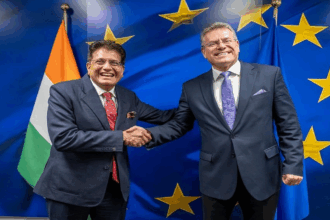
Leaders from India and the European Union are preparing for a major summit on January 27, 2026, just after India’s Republic Day celebrations. The event will bring Indian Prime Minister Narendra Modi together with EU leaders, including European Council President António Costa and European Commission President Ursula von der Leyen. This summit is expected to host a wide range of agreements designed to strengthen cooperation on trade, security, defence, and people mobility.
At the heart of the summit is the long-awaited India–EU Free Trade Agreement (FTA). Negotiations for a trade pact between India and the EU began way back in 2007, but disagreements led to a pause in talks in 2013. Talks were restarted in June 2022 and have now moved very close to a conclusion. During the summit, both sides are likely to formally declare that negotiations are complete, clearing the way for legal reviews and approval by the European Parliament and the European Council. Once finalised and ratified, this FTA would be one of India’s biggest trade agreements, offering greater market access for goods and services between India and the EU.
Several issues are still being refined in the trade deal. One of the more complex areas concerns the Carbon Border Adjustment Mechanism (CBAM), an EU tariff tool that places levies on carbon-intensive imports like steel and cement. Negotiators are working to find a balance that supports both climate goals and fair trade. On the positive side, the two sides have already agreed on sector-specific provisions, including rules for wine and spirits and special tariff quotas for cars and other key products.
Another key outcome expected at the summit is a Security and Defence Partnership (SDP). This pact will push India and the EU to work more closely on defence and security matters. It is expected to promote interoperability between India’s and EU forces, meaning their equipment, training, and operations can better function together. Indian defence firms are also likely to gain access to the EU’s defence support framework called SAFE (Security Action for Europe), a massive €150 billion initiative intended to strengthen defence readiness among EU nations.
Beyond military cooperation, a Security of Information Agreement (SOIA) is expected to be launched. This agreement would make it easier for Indian and EU defence industries to share sensitive information securely. In many defence partnerships, sharing detailed technical data can be restricted, so SOIA could unlock deeper collaboration in areas like defence technology, joint manufacturing, and secure communications.
The summit is also expected to see a memorandum for a mobility framework for Indian workers in Europe. This pact will set a new relationship on worker movement between India and EU countries. Nations such as France, Germany, and Italy already have separate migration and labour arrangements with India. The new framework could expand professional opportunities for Indians in Europe and make legal mobility smoother in key sectors. Officials describe this as a historic step toward closer people-to-people links between India and the EU.
Adding to the symbolism of the visit, the EU will send a small military delegation to take part in India’s Republic Day parade. Flags representing the EU military staff and two naval operations, Operation Atalanta and Operation Aspides, will be displayed. This reflects growing defence cooperation and shared strategic interests.
In summary, the India–EU Summit on January 27 is set to be a landmark diplomatic event. Officials expect several big outcomes, the near-final conclusion of the India–EU Free Trade Agreement, a Security and Defence Partnership, the launch of a Security of Information Agreement, and a new mobility framework for Indian workers in Europe. Together, these initiatives show India and the EU moving toward deeper economic, strategic, and social ties in the years ahead.