



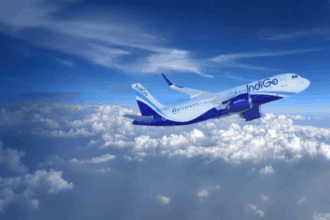
IndiGo, India’s largest airline, reported a sharp fall in profits for the third quarter of FY26, highlighting how operational disruptions and rising employee-related costs can quickly impact even strong market leaders. For the October to December 2025 quarter, IndiGo posted a net profit of ₹549 crore, a steep 75% drop compared with ₹2,448 crore in the same period last year. The result surprised markets, as the airline had otherwise continued to see steady travel demand and revenue growth.
The biggest reason behind the profit collapse was a large set of exceptional one-time expenses totaling ₹1,546.5 crore. A major portion of this was ₹570 crore paid as compensation to passengers after mass flight cancellations in December. Another ₹969 crore was set aside as provisions to restructure pilot pay and employee benefits to comply with new labour rules. These costs heavily weighed on quarterly earnings. Without these exceptional items, IndiGo’s profit would have been over ₹2,000 crore, showing that the underlying business remained profitable, but extraordinary disruptions changed the final numbers.
The operational crisis began in early December 2025, when IndiGo was forced to cancel more than 5,000 flights in a short period. This happened after new pilot rest-hour regulations were implemented, leading to an unexpected pilot shortage. With fewer pilots available to operate scheduled flights, the airline had to cut services, causing inconvenience to passengers and loss of revenue. The cancellations not only reduced flight occupancy but also weakened pricing power, as the airline had to manage customer dissatisfaction and refund pressures.
India’s aviation regulator, the Directorate General of Civil Aviation (DGCA), later stated that IndiGo’s management had not prepared adequately for the rollout of the new rest-hour rules. According to the regulator, the airline’s earlier focus on maximizing aircraft and crew utilization left limited buffer capacity, which made the system vulnerable when new rules took effect. This feedback added to concerns about operational planning at a time when air travel demand remains strong.
Despite the profit fall, IndiGo’s revenue performance remained stable. Revenue from operations rose 6.2% year-on-year to ₹23,471.9 crore, supported by steady passenger demand. However, yield, which measures revenue earned per passenger kilometer, slipped 1.8%. This decline reflects the impact of flight disruptions, lower occupancy on some routes, and pricing pressure following the crisis.
Looking ahead, IndiGo has slightly reduced its overall growth outlook but still plans to increase capacity by about 10% in the next quarter, mainly by expanding international routes. Domestic growth is expected to be slower in the near term, partly due to the DGCA directing a 10% cut in IndiGo’s planned domestic schedule after the disruption episode.
IndiGo’s CEO Pieter Elbers said the airline is strengthening its systems and reviewing how global carriers handle similar large-scale disruptions. He added that while the quarter was challenging, the company’s long-term strategy and market leadership position remain intact.
In summary, IndiGo’s Q3 FY26 results reflect a classic case where strong revenue trends were overshadowed by exceptional operational and regulatory shocks. Pilot shortages, new labour compliance costs, and mass flight cancellations combined to sharply reduce profits, even as demand for air travel stayed resilient.