



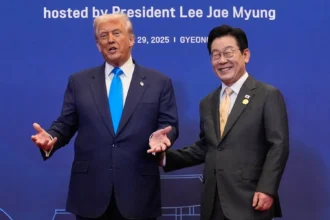
The United States has once again turned to tariffs as a tool of trade pressure. On January 26, 2026, US President Donald Trump announced a sharp rise in import tariffs on goods coming from South Korea. The tariff rate has been increased from 15% to 25%, affecting key export categories such as automobiles, auto parts, lumber and pharmaceuticals. These sectors form an important part of South Korea’s trade relationship with the US, making the decision significant for both economies.
According to President Trump, the tariff hike is a direct response to South Korea’s legislature delaying the approval of a previously agreed trade agreement between the two nations. Trump stated that South Korea’s lawmakers were not fulfilling their part of the deal. Because the agreement has not yet been ratified, the US administration believes the reduced tariff benefit of 15% should be withdrawn, returning to the original 25% rate.
The trade agreement in question was reached in 2025. It aimed to lower US tariffs on South Korean exports, particularly in automobiles and auto parts, making Korean goods more competitive in the American market. In addition, the deal reportedly included commitments from South Korea to invest up to around $350 billion in the United States across strategic industries. This made the agreement not just a tariff pact, but a broader economic partnership.
However, the delay in legislative approval in South Korea has now created friction. The White House argues that without formal ratification, the US is not obligated to continue offering lower tariff rates. As a result, the tariff increase has been announced as a pressure tactic to push the deal forward.
At the time of the announcement, important details were still missing. It was not clear exactly when the new tariffs would take effect or what legal steps would be used to implement them. Neither the US Trade Representative nor South Korea’s presidential office had immediately released official responses. This uncertainty leaves businesses and investors unsure about how quickly the new tariffs will impact trade flows.
This move fits into Trump’s broader trade strategy. Throughout his political career, tariffs have been used as leverage to push other nations into renegotiating trade terms. Supporters see this as a strong stance to protect domestic industries and secure better deals. Critics, however, warn that frequent tariff changes can disrupt supply chains, increase costs for companies, and eventually raise prices for consumers.
For South Korea, the tariff hike is a setback, especially for its automobile and pharmaceutical exporters. Higher US tariffs could make Korean products more expensive in the American market, affecting demand and profitability. For US consumers, the move could lead to higher prices on imported cars, medicines, and construction materials linked to lumber.
On a broader level, the announcement signals that trade tensions between the US and its key partners remain active. It also shows how legislative delays in international agreements can quickly lead to economic consequences. Until South Korea’s legislature approves the trade pact, further uncertainty is likely to remain.
In simple terms, the US has raised tariffs on South Korean goods because a promised trade agreement has not yet been formally approved. The decision increases pressure on South Korea’s lawmakers, but also introduces fresh uncertainty into global trade at a time when markets are already sensitive to policy shifts.