




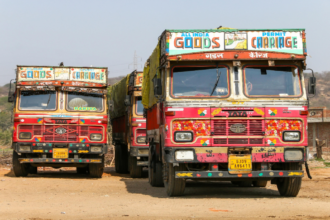
India’s economic activity showed encouraging momentum in February 2026 as the number of e-way bills generated across the country increased significantly. According to data reported by Goods and Services Tax Network (GSTN), total e-way bills generated during the month reached 132.6 million, marking an 18.8% rise compared with the same period last year.
Although the figure was slightly lower than January’s 136.8 million, it still stands as the third-highest monthly total recorded so far. The record for the highest monthly generation remains 138.4 million bills in December 2025, which came after GST rate cuts announced in September.
An e-way bill is a digital document required under India’s Goods and Services Tax (GST) system whenever goods worth more than ₹50,000 are transported. The document contains key details such as the sender, receiver, transporter, and nature of the goods being moved. Its primary purpose is to ensure transparency in the movement of goods, reduce tax evasion, and help authorities track shipments in real time across state and regional borders.
The increase in e-way bill generation is often considered an important leading indicator of economic activity because it directly reflects the movement of goods within the economy. When businesses produce, dispatch, and transport more goods, it typically signals stronger trade flows, manufacturing activity, and consumer demand.
Experts believe the nearly 19% annual growth in February indicates that supply chains remain active and resilient. Higher goods movement suggests that manufacturers, wholesalers, and retailers are actively shipping products across markets. This in turn reflects improving consumption demand and healthy trade activity.
Tax specialists also point out that sustained growth in e-way bill generation highlights the continued strengthening of GST compliance among businesses. As more firms adopt digital documentation and formal reporting mechanisms, the transparency and efficiency of the tax system improve.
Another implication of stronger e-way bill generation is its potential impact on GST collections. Since goods movement often precedes final sales, rising e-way bills can signal stronger tax revenues in the coming months. This makes the indicator closely watched by policymakers, economists, and investors.
The growth in goods movement also aligns with broader economic projections. Government estimates suggest that Private Final Consumption Expenditure (PFCE) — a key measure of consumer spending — is expected to grow 7.7% in real terms in FY26, compared with 5.8% in FY25. In nominal terms, consumption spending is projected to expand 8.9%, with its share in GDP increasing slightly to 56.7%.
Meanwhile, India’s GDP growth for FY26 is projected at around 7.6%, compared with 7.1% in the previous year based on revised economic estimates. Strong consumption growth, steady manufacturing activity, and continued trade movement are all contributing factors to this outlook.
Overall, the rise in e-way bill generation in February highlights healthy trade flows, stronger consumption demand, and increasing GST compliance across the Indian economy. While monthly figures may fluctuate, the underlying trend suggests that economic activity and goods movement remain robust, supporting expectations of sustained growth in the coming months.