• Due to the increased margin requirements for customers in the F&O segment, the company’s funds with the banks might increase, leading to an increase in the interest income. On the other hand, the income from lending activities might see a slight decline due to these same restrictions. To offset this effect on the revenue, the company has introduced interest on disproportionate non-cash collateral offered as margin exceeding ₹50,000.
• The fee and commission income, mainly the brokerage income will see an even further uptick for the company, as the number of demat accounts in India almost quadrupled from 4 crore in FY20 to about 15 crore in FY24. 5 With the company’s strong acquisition and retention rate, ANGELONE will surely expand its customer base further and increase its market share in the coming years.
• The ancillary transaction income will be the most negatively impacted due the introduction of the true-to-label transaction costs by SEBI. The company has introduced brokerage on cash delivery segments in order to minimize this impact.
• Additionally, in the light of these new SEBI regulations, the company expects a short-term slow down in trading volumes and continues to monitor client behavior but believes that these regulations will strengthen the market in the long-term. The management conveyed that the company expects a short-term impact of 13%-14% to be felt on the total income from clients. The management has also said it will focus on diversifying its revenue streams and acquiring more market share in order to minimize any decline in profitability due to the SEBI regulations and the overall cyclical nature of the broking industry.
• In short, the broking revenue are expected to continue to rise at a good pace, as ANGELONE has implemented a couple of new policies to offset the effect of the new SEBI regulation that might affect revenue.
II. Expenses
Fee and Commission Expenses
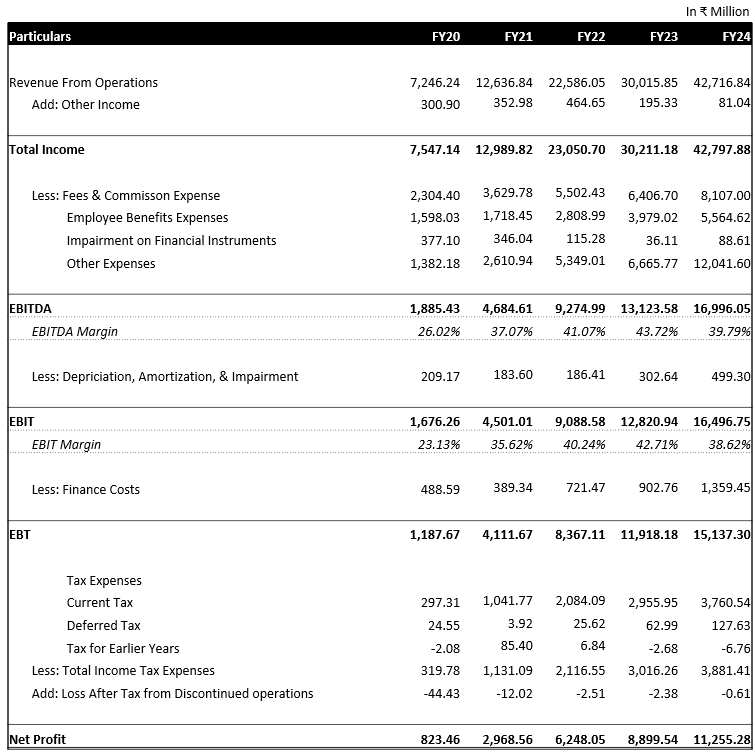
• ANGELONE saw an increase in the fees and commission expense in the FY24, where it rose from ₹6.4 billion in FY23 to ₹8.1 billion, representing a 26.54% increase.
• This change was heavily influenced by the increase in pay-out for the company’s network of Authorized Personnel and Digital Referral Associates (DRAs), who are owed a part of the revenue earned from clients acquired through them. The growth in the company’s client base facilitated a huge rise in its ADTO which increased by 143.5% to ₹33.2 trillion which finally led to the increase in the fee paid to these Authorized Personnel and DRAs.
Employee Benefit Expenses
• The employee benefit expenses saw an increase of 39.85% YoY in FY24 and this growth rate has been gradually decreasing after spiking in FY22 at 63.46%.
• These expenses saw a rise due to the increase in staff as well as salaries and new hires regarding expansion into the asset management and wealth management segments, coupled with stock option grants at a higher cost.
Other Expenses
• The company noted an increase in other expenses, which rose from ₹6.7 billion in FY23 to ₹12 billion in the FY24, representing an 80.65% YoY increase.
• The biggest part of these other expenses, which account for about 61.67% of it was the spends on advertisement and publicity which amounted to ₹7.4 due to the increase in gross client acquisition and the number of orders. These expenses also included the costs of about ₹0.23 Billion relating to the Indian Premier League sponsorship.
• Next, 18.34% of these expenses were gone towards software connectivity license and maintenance.
• Exchange and statutory charges grew from approximately ₹267 million in FY23 to about ₹669 million in FY24, indicating an increase of 150.82%.
• The rest of the expenses were accounted for though increased demat charges to depository due to higher client activity in the cash delivery segment, legal and professional charges and increase in CSR spends.
Future Outlook:
• Taking into account these changes, the expenses for the company have a change of growing at a rate of 15% - 20% CAGR.
• As an after effect of the increasing client base, the fee and commission expenses will increase as more clients get acquired through referral, hence, increasing the fee paid to Authorized Personnel and DRAs.
• Moreover, with the ongoing expansion of the company into asset management and wealth management, more professionals who hold expertise in these fields will be onboarded, resulting in an increase in employee benefit expenses in the near future.
• The advertisement and publicity expenses, under the other expenses head, are expected to increase as the company plans on expanding into asset management and wealth management, which will require ANGELONE to increase its spending on advertising and publicity.
• Overall, ANGELONE’s expenses will see an increase due to onboarding of new client and the expansion of the company into new business segments.
III. EBITDA
• The EBITDA of the company grew from around ₹13 billion in FY23 to about ₹17 billion in FY24. The company’s EBITDA growth rate has been gradually decreasing as in FY21 it grew at a rate of 148.46% but in FY23 and FY24, it grew by just 41.49% YoY and 29.51% YoY, respectively.
• The EBITDA margin reduced from 43.72% in FY23 to 39.79% in FY24. This reduction in margin is partially related to the increase in the impairment on financial instruments expenses, which were decreasing from FY20, but increased by 145.39% YoY to approximately ₹89 million and the increase in other expenses.
• Future Outlook: The EBITDA is expected to experience growth of approximately 20%-25% CAGR for a short period, then, as the new business segments start to generate revenue, it is expected to rise higher, leading to an increase in the EBITDA margin, as the company has to incur expenses to set up their potential revenue drivers before they start to generate revenue.
IV. EBIT
• The EBIT of the company, which grew from ₹12.8 billion in FY23 to ₹16.5 billion in FY24 represented a growth rate of 28.67% YoY.
• The company’s EBIT margin reduced from 42.71% in FY23 to 38.62% in FY24, as an effect of the decrease in the EBITDA margin.
• Future Outlook: Same as the case for EBITDA, the EBIT is also expected to be have a growth of approximately 20%-25% CAGR in the short run and then rise higher as an after effect of the EBITDA. The EBIT margin is expected to increase gradually as well.
V. EBT
• The company’s EBT increased to approximately ₹15 billion in FY24 from about ₹12 billion in FY23. This number has also seen a decrease in growth rate over the past five years. This EBT increased by 42.44% YoY in FY23 but in FY24, it grew by just 27.01%.
• Future Outlook: Taking into account the YoY growth rate of the company, in addition to the increase in finance costs due to possible additional debt financing, the EBT of the company is also expected to grow at a CAGR of 20%-25% in the future.
VI. Tax Expenses
• The total income tax expenses grew by 28.68% to ₹3.9 billion, mostly constituting of current tax expenses of about ₹3.8 billion. This growth rate has also been decreasing over the years. Moreover, this expanse has been gradually increasing, mirroring the income of the company.
VII. Net Profit
• Finally, the Net Profit for the company grew to ₹11.3 billion in FY24, indicating a growth rate of 26.47%, from ₹8.9 billion in FY23. This growth rate, same as the growth rate for EBITDA and EBIT, has been decreasing over the years.
• The net profit is increasing in line with the income of the company through the years and has been showing a consistent growth in net profit margin though FY21 to FY23, only decreasing slightly by -11.13%, resulting in a margin of 26.35%.
• Future Outlook: Overall, the company’s net profit has been growing at a CAGR of 92%, and with the changes the company has implemented to curb the effect of the new SEBI regulations coupled with their plans to expand their business segments and goals to increase market share, the Net Profit is sure to see good growth in the coming years.
Commentary on Statement of Balance Sheet:
I. Assets
Financial Assets
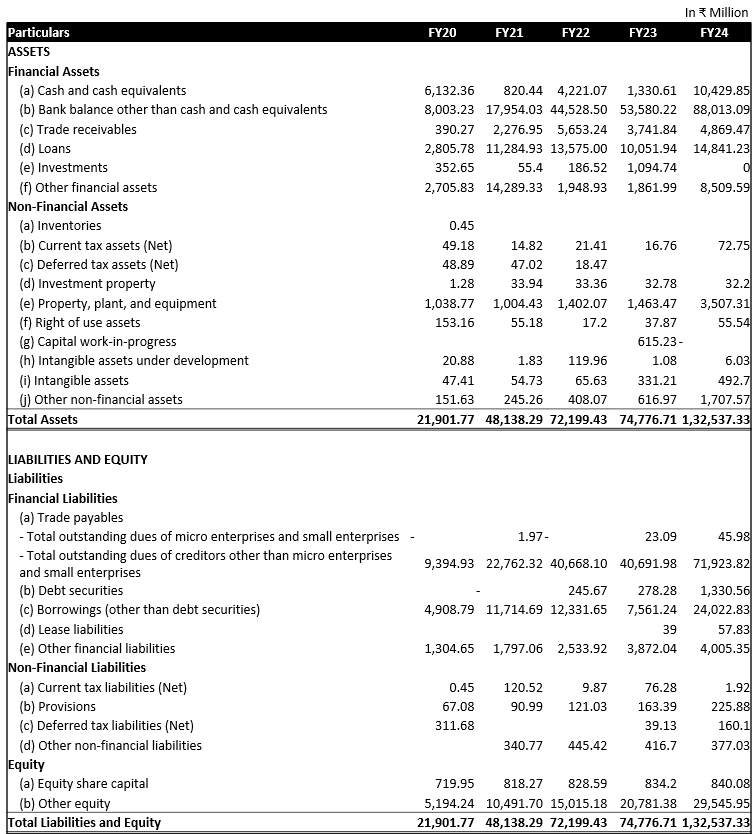
• Cash and Cash equivalents constituted 7.87% of the total asset and grew from about ₹1.3 billion to approximately ₹10.4 billion in FY24, increasing almost 8x. This increase was led by an increase in client’s margin, along with cash generated from business operations. During the year, the company’s client funding book increased by 54.1% to almost ₹18 billion, which in turn increased the company’s balances with the banks. Taking into account the new regulations by SEBI, which increased the value of margin requirements, this balance will possibly multiply further. Moreover, this hefty rise has improved the liquidity position of the company.
• Next, 66.41% of the total assets was bank balance other than cash and cash equivalents. These balances amounted to about ₹88 billion, increasing by 64.26% YoY. This increase was led by short-term fixed deposits with banks and has been relatively stable for the past three years. These deposits also add to the company’s position to meet short term demands for cash.
• During the year, the company decided to liquidate its investments, decreasing the amount of about ₹1.1 billion in FY23 to nil in FY24.
• Loans given amounted to about ₹14.8 billion on the company’s balance sheet, increasing by 47.65%. This was mainly led by the growth in the client funding segment of the company’s business. As mentioned, ANGELONE’s margin trading books increased by 54.1%, but due to the higher margin requirements, this number might see a small dip for a short period of time.
• The company’s other financial assets grew almost 4.6x to about ₹8.5 billion. During the year, the security deposits kept with stock exchanges increased to ₹8.1 billion, leading to this sudden increase.
Non-Financial Assets
• The non-financial assets of the company have seen steady growth in the last three years, amounting to a total of approximately ₹5.9 billion, representing an 88.55% YoY increase.
• This increase was led by the rise in plant, property and equipment, which grew by almost 2.4x reaching ₹3.5 billion. The reason for this was the addition of new computer equipment to grow the company’s investment in its technological infrastructure. This is a smart move by ANGELONE, as due to the extremely competitive nature of the online discount broking industry, there is a need for the company to continuously bring innovative technological advancements.
• The other non-financial assets of the company grew to be about ₹1.7 billion at the year end, increasing by almost 2.8x. The increase in prepaid expanses and advances to venders by the company, coupled with the balances with government authorities facilitated this increase.



Comments
Log in to comment and join the discussion.
No comments yet. Be the first to comment.