





Written By: Gouri Malik
In the unpredictable world of stock investing, where market volatility can turn fortunes upside down in a moment, there exists a powerful concept that has protected investors from catastrophic losses. The “Margin of Safety” is not just a financial principle; it’s a strategic approach that separates disciplined investors from speculative gamblers. Popularized by legendary value investor Benjamin Graham and championed by his most famous student, Warren Buffett, this concept is your financial armor in the battlefield of stock markets.
Understanding Margin of Safety: More Than Just a Number
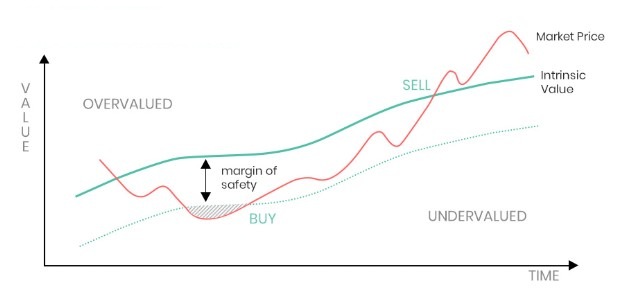
Margin of Safety is a fundamental principle that provides a buffer between the intrinsic value of a stock and its market price. At its core, this concept is about protecting yourself from the inevitable uncertainties and potential mistakes in investment analysis.
By intentionally purchasing securities at a price significantly below their calculated intrinsic value, investors create a cushion that can absorb market fluctuations, unexpected company challenges, and broader economic uncertainties.

Lets take a Case Study: Apple Inc. (AAPL) Stock Valuation
Company snapshot:
| Current Stock Price | $175 |
| Outstanding Shares | 16.7 billion |
| Annual Revenue | $394.3 billion |
| Net Income | $96.9 billion |
| Free Cash Flow | $111.4 billion |
| Earnings Per Share | $5.81 |
Let’s say we use Discounted Cash Flow Calculation and find out the sum of Future Discounted Cash Flows come out to be $577 bn.
So, Per Share Intrinsic Value = $577Bn / 16.7Bn = $34.55
Margin of Safety Calculation
Margin of Safety (%) = [(Intrinsic Value – Market Price) / Intrinsic Value] × 100
= [($34.55 – $175.00) / $34.55] × 100
= -406.30%
Interpretation
The negative margin of safety of -406.30% indicates a substantial deviation between the calculated intrinsic value and the current market price. This suggests the stock is trading at a premium far above its fundamental value based on our conservative cash flow projections.
The extreme difference suggests the market is pricing in:
- Exceptional future growth prospects for the Company
- Potential breakthrough innovations
- Strong brand value and market dominance of AAPL
- Anticipated expansion into new markets by the investors
Investment Decision Framework for the above case study
| Avoid Immediate Purchase | Waiting Strategy |
| Current valuation suggests high risk and therefore, potential for significant price correction. | Monitoring for price normalization and looking for entry points closer to intrinsic value |
| Partial Position | Options Strategies |
| Consider small, incremental investments and implement dollar-cost averaging. | Using put or call options to create hedging mechanisms and limiting potential downside risk |
Connecting Margin of Safety with Other Investment Criteria
1. Price-to-Earnings (P/E Ratio)
The Price-to-Earnings ratio serves as an excellent complementary metric to the Margin of Safety principle. A lower P/E ratio can indicate that a stock is potentially undervalued, providing an additional layer of safety. However, investors must compare this ratio with industry benchmarks and understand the context of the company’s specific situation. A low P/E isn’t always a definitive signal of value; it could also indicate underlying problems with the company or industry.
2. Debt-to-Equity Ratio
Financial stability is a critical component of investment safety. The Debt-to-Equity ratio provides insights into a company’s financial leverage and risk profile. A lower debt-to-equity ratio suggests that a company has a more stable financial structure, contributing to a stronger margin of safety. This metric helps investors assess a company’s ability to meet its financial obligations and withstand economic downturns.
What is a good margin of safety percentage?
Most value investors seek a margin of safety of at least 30-50%. This range provides a substantial buffer against potential investment errors or market volatility. However, the ideal percentage can vary based on the specific investment, industry characteristics, and individual investor risk tolerance.
Does a high margin of safety guarantee no losses?
Absolutely not. While a high margin of safety significantly reduces risk, it doesn’t eliminate it entirely. Investment always involves some level of uncertainty. The margin of safety is a risk management tool that improves the probability of successful investment outcomes, not a guarantee of profit.
How often should an investor recalculate margin of safety?
Regular review is crucial. Quarterly assessments are recommended, or whenever significant company-specific events, industry changes, or macroeconomic shifts occur. Continuous monitoring ensures that your investment thesis remains valid and that the margin of safety remains adequate.
Conclusion
Margin of Safety is more than a mathematical calculation; it’s a profound investment philosophy that prioritizes risk management and disciplined analysis. By embracing this principle, investors transform from speculative traders to strategic, thoughtful market participants who understand that preserving capital is just as important as generating returns.