



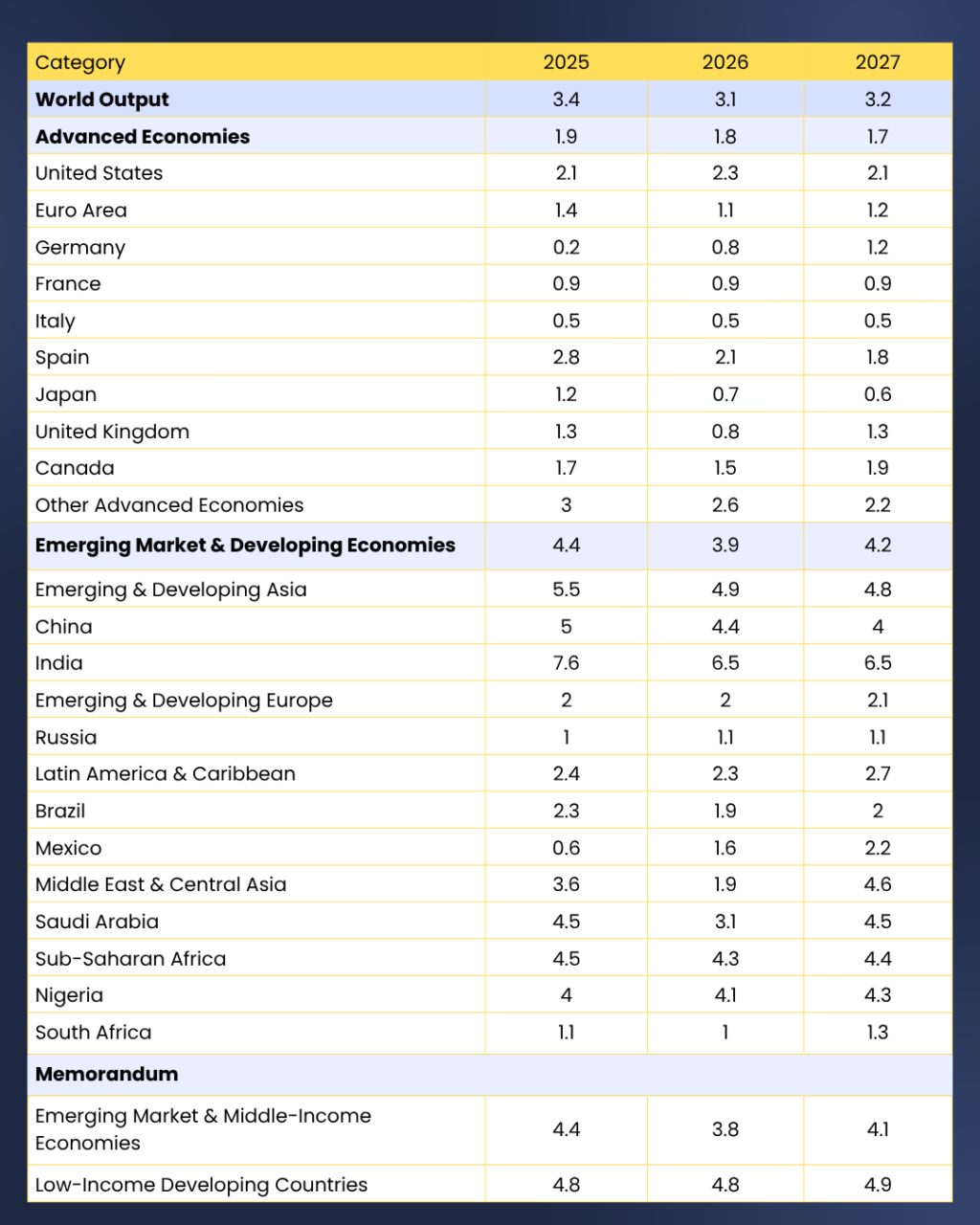
The latest World Economic Outlook released by the International Monetary Fund highlights a slowdown in global growth for 2026, reflecting rising geopolitical and energy-related risks. The IMF has revised its global growth forecast downward to 3.1% for 2026, a cut of 0.2% points from its earlier estimate. The downgrade is largely attributed to the ongoing conflict in West Asia, which has disrupted energy markets and raised concerns about a prolonged global economic impact.
According to the report, the conflict involving the United States, Israel, and Iran has created significant uncertainty, particularly in oil supply. Disruptions linked to the closure of key transit routes such as the Strait of Hormuz and damage to critical energy infrastructure have pushed energy prices higher. The IMF expects oil prices to rise by over 21% in 2026, with average prices hovering around $82 per barrel. This increase in energy costs is feeding into inflation, which is projected to reach 4.4% globally in 2026 before moderating slightly to 3.7% in 2027.
The IMF notes that without the ongoing conflict, global growth could have been stronger at around 3.4%, indicating that geopolitical tensions alone have shaved off nearly 0.3% points from the global growth outlook. The report emphasizes that central banks may need to respond decisively to inflationary pressures, especially if energy prices remain volatile.
Despite the global slowdown, India stands out as a relatively strong performer. The IMF has marginally upgraded India’s growth forecast to 6.5% for both 2026-27 and 2027-28, up from its earlier estimate of 6.4%. This resilience is attributed to strong domestic demand, supportive policy conditions, and robust growth momentum observed in recent quarters. Additionally, relatively lower trade pressures, including reduced tariffs from the United States, have supported India’s economic outlook.
However, the report also cautions that India is not entirely insulated from global risks. Inflation in India is projected at around 4.7% in 2026-27, easing to 4% in the following year, broadly aligning with expectations from the Reserve Bank of India. External shocks, particularly from energy markets, remain a key risk factor.
The impact of the conflict is far more severe for countries directly affected by the crisis. For instance, Iran’s economy is expected to contract sharply by 6.1% in 2026, compared to an earlier expectation of growth, underscoring the economic strain on war-impacted regions.
Looking ahead, the IMF has outlined multiple scenarios depending on how the conflict evolves. In its base case, the war is expected to ease in the coming months, allowing global growth to stabilise at 3.1%. However, in a more adverse scenario, where oil prices rise to around $100 per barrel, global growth could fall further to 2.5% in 2026. In a severe scenario, with oil prices exceeding $110, growth could drop close to 2%, bringing the global economy near recessionary conditions.
Overall, the report underscores how geopolitical tensions, particularly those affecting energy markets, are reshaping the global economic outlook. While many economies face increasing pressure from inflation and slowing growth, India continues to demonstrate relative resilience, supported by strong domestic fundamentals and policy stability.