



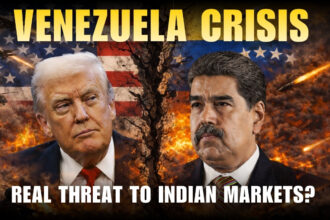
The recent crisis in Venezuela, triggered by a major military operation by the United States, has drawn global attention because the country holds the world’s largest proven crude oil reserves. The situation has raised concerns about possible disruptions to global energy markets and their impact on major economies. However, despite the seriousness of the event, India is expected to remain largely insulated from any immediate economic shock.
According to reports, the US action involved the capture of Venezuelan President Nicolás Maduro on charges linked to alleged narco-terrorism and drug trafficking. While the geopolitical implications are significant, experts point out that India’s direct economic exposure to Venezuela is very limited, which reduces the risk of spillover effects.
One of the main reasons India is unlikely to be heavily affected is the sharp decline in trade between the two countries over the past few years. Data cited by the Global Trade Research Initiative (GTRI) shows that India’s total imports from Venezuela in 2024–25 stood at only about USD 364.5 million. Out of this, crude oil imports accounted for roughly USD 255.3 million. This was a steep drop of over 80% compared to the previous year, when India imported crude worth around USD 1.4 billion from Venezuela.
India’s exports to Venezuela are also quite small. In 2024–25, exports were valued at about USD 95.3 million, with pharmaceuticals forming the largest share. These modest numbers clearly indicate that Venezuela does not play a major role in India’s trade ecosystem today.
Historically, India was once an important buyer of Venezuelan crude, especially during the 2000s and early 2010s. However, this relationship weakened significantly after the United States imposed strict sanctions on Venezuela in 2019. These sanctions discouraged Indian refiners from importing Venezuelan oil due to the risk of secondary penalties. As a result, Indian companies gradually reduced their exposure, and bilateral trade volumes declined sharply.
Because of this reduced engagement, experts believe the current crisis will not have a meaningful impact on India’s economy or energy security. India sources most of its crude oil from regions such as the Middle East, Russia, and parts of Africa. With diversified suppliers already in place, any disruption in Venezuelan oil supplies is unlikely to affect India’s fuel availability in a significant way.
That said, the broader global impact of the crisis cannot be completely ignored. Venezuela’s economy depends heavily on crude oil, and any escalation could increase global supply risks. Rising geopolitical tension often leads to higher crude oil prices due to fear of supply disruptions. If oil prices rise sharply, India could feel indirect pressure through higher import costs, which may affect inflation and corporate margins.
Market experts also point out that geopolitical uncertainty usually increases demand for safe-haven assets like gold and silver. In the short term, such events can lead to volatility in financial markets, including Indian equities. Sectors that are sensitive to fuel costs, such as airlines, logistics, paints, and FMCG, may face temporary pressure if crude prices move higher.
However, analysts stress that these risks are largely short-term in nature. There is no immediate reason for panic in Indian markets, as the country’s economic fundamentals remain stable. Long-term investors are advised to stay disciplined and continue systematic investments, using market dips as potential opportunities rather than reacting to fear.
From a strategic perspective, GTRI has highlighted the need for India to remain cautious in an increasingly volatile global environment. As global competition over natural resources and energy intensifies, India must protect its strategic autonomy, diversify energy sources, and avoid over-dependence on geopolitically unstable regions.
In summary, while the Venezuela crisis is serious from a global geopolitical standpoint, India’s limited trade exposure and diversified energy sourcing mean the direct impact is likely to be minimal. Any effects on crude prices or market sentiment are expected to be temporary, making India largely insulated from the immediate shock.