



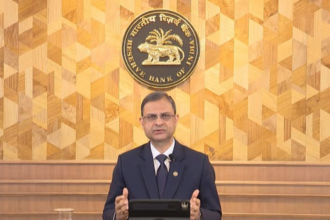
The Monetary Policy Committee (MPC) of the Reserve Bank of India has decided to keep the repo rate unchanged at 5.25% in its latest policy meeting, maintaining a “neutral” stance under Governor Sanjay Malhotra. The decision was unanimous, signaling a continuation of the central bank’s cautious and data-dependent approach amid rising global uncertainties. The policy reflects a clear “wait-and-watch” strategy, with the RBI choosing stability over immediate action in a volatile macroeconomic environment.
One of the key reasons behind the decision to hold rates steady is the heightened global uncertainty, particularly due to ongoing geopolitical tensions such as the US–Iran conflict. These developments have increased volatility across financial markets and created uncertainty around both inflation and growth trajectories. In such a scenario, the RBI has opted to avoid any aggressive policy moves that could amplify instability.
Another critical factor influencing the decision is the sharp volatility in crude oil prices. Fluctuations in oil prices have a direct impact on inflation, fiscal dynamics, and currency stability. With oil markets reacting to geopolitical developments, the RBI has remained cautious, as any sudden spike in prices could quickly alter the inflation outlook. Additionally, the Indian rupee has been under pressure due to global risk-off sentiment and capital outflows. A rate cut in such conditions could further weaken the currency, limiting the RBI’s room for easing.
The policy highlights a delicate balance between growth and inflation. While domestic growth remains relatively resilient, external shocks pose a significant risk to economic momentum. At the same time, inflation appears to be under control for now, but remains vulnerable to supply-side shocks, particularly from energy prices. This creates a complex trade-off for the central bank, which aims to support growth without triggering inflationary pressures or destabilizing the currency.
Importantly, the RBI has flagged a new risk in its policy communication, the possibility of a “demand shock.” This refers to a sudden slowdown in consumption, investment, and overall economic activity. Such a risk could emerge from global instability, weaker external demand, or rising input costs that reduce purchasing power. The mention of demand shock marks a subtle shift in the RBI’s focus, indicating that concerns are no longer limited to inflation but are increasingly centered around sustaining growth.
The continuation of a “neutral” stance gives the RBI flexibility to respond to evolving conditions. It retains the option to either cut rates if growth slows sharply or hike rates if inflation resurges. This approach underscores the central bank’s intent to remain agile and responsive rather than committing to a fixed policy direction.
From a market perspective, the policy is expected to keep bond yields relatively range-bound, as there was no major surprise in the decision. The rupee will remain under close watch, with stability being a key priority for policymakers. Additionally, the RBI’s focus is gradually shifting toward liquidity management and ensuring effective transmission of past rate actions, rather than relying solely on rate changes.
In summary, the RBI’s latest policy reflects a cautious stabilization phase, shaped by global risks, oil price volatility, and currency pressures. By holding rates steady and maintaining flexibility, the central bank is positioning itself to navigate an uncertain macroeconomic landscape while closely monitoring both inflation risks and emerging threats to growth.